ASIS PCI Certification: Build Your Career in Professional Investigations
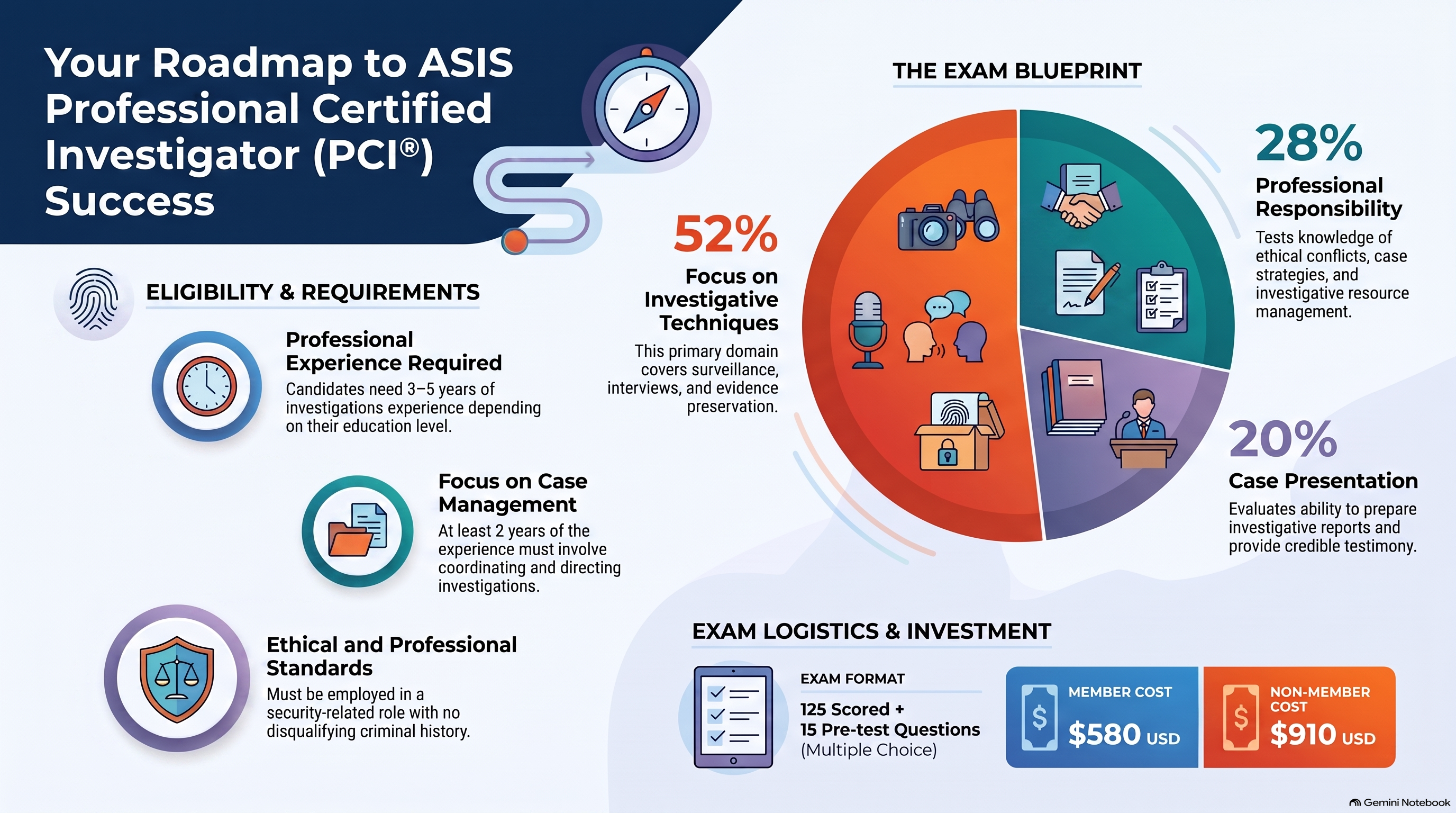
The ASIS PCI certification, formally the Professional Certified Investigator (PCI®), is an experience-based board certification from ASIS International for professionals who manage investigations, collect and assess evidence, conduct interviews and surveillance, and present investigative findings. Candidates need three to five years of investigations experience depending on education, including at least two years in case management. The exam has 140 multiple-choice questions, lasts 2.5 hours, and tests Professional Responsibility, Investigative Techniques and Procedures, and Case Presentation across real-world security investigation scenarios.
What Is the ASIS PCI certification?
The ASIS PCI certification is the Professional Certified Investigator (PCI®) credential offered by ASIS International. It is designed for experienced investigation professionals whose work involves case management, evidence collection, investigative techniques, reporting, and presentation of findings. Unlike a basic investigation course, the credential does not simply prove that you completed training. ASIS board certification combines documented professional experience with a formal examination.The professional certified investigator PCI credential can be particularly relevant for professionals working in:
- Corporate investigations
- Fraud and financial investigations
- Loss prevention
- Workplace investigations
- Forensics
- High-tech and cybercrime investigations
- Insurance fraud
- Threat assessment
- White-collar crime
- Property and casualty investigations
- Security and risk functions
One important distinction: ASIS PCI is not PCI DSS certification. If you search for PCI Security Certification, you may see results relating to payment card security. The ASIS credential discussed here certifies an individual investigator's professional competence, not an organization's payment-card compliance.
Professional Certified Investigator PCI Certification: Who Is It For?
The Professional Certified Investigator PCI Certification is best suited to professionals who already investigate cases rather than people trying to enter investigations with no practical experience. Strong candidate profiles include corporate investigators, internal investigators, fraud specialists, loss-prevention professionals, security investigators, compliance investigators and experienced professionals moving from law enforcement or government investigation roles into corporate security. This is also an important distinction when discussing PCI Certification for Individuals: ASIS certifies the qualified professional. It is not a company-level security certification. PCI validates specialized investigation capabilities, including evaluating cases, selecting case-management strategies and gathering information through techniques such as surveillance, interviews and interrogations.
PCI Certification Requirements
The PCI Certification Requirements depend partly on your level of higher education. Every route requires significant investigations experience and at least two years of case-management experience.
| Education Level | Investigations Experience | If You Hold APP | Case Management |
| No higher education degree | 5 years | 4 years | At least 2 years |
| Bachelor's degree or equivalent | 4 years | 3 years | At least 2 years |
| Master's degree or equivalent | 3 years | 3 years | At least 2 years |
Case management involves coordinating and directing an investigation using suitable resources and investigative disciplines, then evaluating the collected information to determine the facts and findings of the case. Applicants must also have relevant professional security experience and satisfy applicable certification conduct and application requirements. A useful eligibility insight is that performing isolated investigative tasks is not necessarily the same as having case-management experience. If you primarily collect evidence or conduct interviews but another person plans, directs and coordinates the complete investigation, verify carefully whether your experience meets the case-management requirement before applying.
ASIS PCI Certification Exam Format
The ASIS PCI Certification examination focuses heavily on applying investigation knowledge rather than simply memorizing definitions.
| Exam Detail | PCI Information |
| Total questions | 140 |
| Scored questions | 125 |
| Unscored/pretest questions | 15 |
| Question format | Multiple choice |
| Exam time | 2.5 hours |
| Passing scaled score | 650 or higher |
| Testing provider | Prometric |
| Testing options | Test center or remote proctored |
| Availability | Year-round |
| Languages | English and Spanish |
Candidates cannot identify which 15 questions are unscored, so every question should be treated as if it contributes to the final result. The examination uses scaled scoring rather than simply calculating a raw percentage of questions answered correctly.
ASIS PCI Exam Domains
The examination covers three major domains:
| Domain | Exam Weight |
| Professional Responsibility | 28% |
| Investigative Techniques and Procedures | 52% |
| Case Presentation | 20% |
The weighting immediately shows where preparation effort should go. Investigative Techniques and Procedures represents 52% of the examination, making practical investigative decision-making the largest part of the test.Professional Responsibility accounts for 28%, while Case Presentation represents 20%.
What Do the Domains Actually Test?
Professional Responsibility addresses ethical issues, applicable laws and regulations, case assessment, investigative strategy, risk, resources and professional decision-making.Investigative Techniques and Procedures is the core of the exam. Candidates should be comfortable applying methods connected with information collection, evidence, interviews, surveillance, investigative technologies, forensic concepts, specialized investigations and related procedures.Case Presentation focuses on turning investigative work into defensible findings. This includes preparing reports that support conclusions and communicating investigative results appropriately.That structure explains why experienced investigators may still find the exam challenging. Knowing how your employer conducts investigations is not enough. Candidates must understand professional investigation principles and apply them in different scenarios.
ASIS PCI Certification Cost
The ASIS PCI certification cost varies according to ASIS membership and applicable market classifications.
| Candidate Category | Exam Fee |
| ASIS Member | $580 |
| ASIS Member – Emerging Market 1 | $480 |
| ASIS Member – Emerging Market 2 | $460 |
| Nonmember | $910 |
| Nonmember – Emerging Market 1 | $720 |
| Nonmember – Emerging Market 2 | $680 |
The standard retake fee may also apply if a candidate needs another attempt.Therefore, when calculating the total ASIS PCI Certification Cost, do not consider only the examination fee. Your overall preparation budget may also include:
- Official reference materials
- Study guides
- Practice questions
- Mock examinations
- Review courses
- PCI Certification Training
ASIS membership is not mandatory for earning the credential, although members may receive reduced certification-related pricing. Because certification pricing can change, candidates should always confirm the latest PCI Certification Cost before submitting an application.
How to Get PCI Certification
The How to Get PCI Certification process involves several important steps.
- Confirm your eligibility.
Match your education and investigation experience to the required eligibility pathway. - Verify your case-management experience.
Make sure you can document at least two years of qualifying case-management work. - Prepare your application information.
You may need professional history, education documentation, references, supervisor details and other supporting information. - Submit the certification application.
- Receive authorization to test.
- Schedule your examination.
Candidates may be able to choose between a testing center and remote-proctored examination. - Prepare using the current examination Body of Knowledge.
- Take and pass the PCI examination.
- Maintain the certification through continuing professional education.
The PCI Certification Process is therefore more than simply purchasing an exam voucher and booking a test. Experience verification is an important part of certification. Candidates should describe their investigation responsibilities clearly and accurately when submitting their application.
PCI Certification Training: How to Prepare Effectively
Effective PCI Certification Training should be built around scenarios rather than endless memorization. Candidates should begin by reviewing the current Body of Knowledge and evaluating their experience against each exam domain.A focused preparation plan should include:
- 52% emphASIS on investigative techniques and procedures
- Scenario-based investigation questions
- Ethical and legal issue analysis
- Interview and interrogation concepts
- Surveillance principles
- Evidence and information handling
- Investigation planning
- Case-management strategies
- Report preparation
- Presentation of investigative findings
- Timed mock examinations
- Review of weak domains after practice tests
A common preparation mistake is spending equal study time on every domain.The examination weights are 28%, 52% and 20%, which means candidates should place additional preparation emphasis on Investigative Techniques and Procedures while maintaining adequate knowledge across all three areas. Candidates should also practice answering questions that ask for the BEST, MOST appropriate, FIRST, or PRIMARY investigative action.These questions test judgment rather than simple recall.
ASIS PCI vs Other Security Certifications
People searching ASIS PCI, PCI certification ASIS, or similar phrases sometimes confuse PCI with broader cybersecurity or security-management credentials.PCI has a very specific specialization: professional investigations.It is most relevant when your work involves:
- Managing investigations
- Conducting interviews
- Collecting evidence
- Evaluating investigative information
- Managing investigative resources
- Developing case strategies
- Preparing investigative reports
- Presenting findings
If your role primarily involves enterprise security leadership, another management-focused security credential may be more appropriate. If your work is mainly focused on physical-security assessments and protection systems, a physical-security credential may align better. PCI provides the strongest alignment when professional investigations form a significant part of your job responsibilities.
Benefits of ASIS PCI Certification
Earning the ASIS PCI Certification can help experienced professionals demonstrate specialized knowledge in professional investigations.Potential benefits include:
- Professional credibility in investigation-related roles
- Formal validation of investigative experience
- Recognition of case-management skills
- Stronger professional positioning
- Greater credibility when handling complex investigations
- Validation of investigative reporting skills
- Improved understanding of professional standards
- Career development opportunities
- Broader knowledge beyond employer-specific procedures
For experienced investigators, the certification can help demonstrate that their abilities extend beyond one organization, industry or internal investigation methodology.
Is the ASIS PCI Certification Worth It?
The credential can be valuable for experienced investigation professionals who want formal third-party recognition of their expertise. Its value is strongest when the certification matches the work you already perform.For example, a corporate fraud investigator who manages complex investigations can use PCI to validate a broader professional skill set covering:
- Investigation planning
- Information gathering
- Professional responsibility
- Investigative techniques
- Case management
- Evidence handling
- Reporting
- Presentation of findings
The certification is less suitable as an entry-level credential because the eligibility requirements are deliberately built around professional experience. Someone with no investigation background should first focus on developing practical investigation knowledge and professional experience before pursuing PCI.
Your Next Step Toward PCI Certification
Start by comparing your education, total investigation experience and two years of case-management experience against the PCI eligibility requirements.Then evaluate your preparation against the examination weighting:
- Professional Responsibility – 28%
- Investigative Techniques and Procedures – 52%
- Case Presentation – 20%
If you already meet the experience requirements, move from general reading to structured, scenario-driven preparation. The ASIS PCI certification is designed to test how effectively you apply investigative judgment, manage cases and communicate findings—not simply how many investigation terms you can memorize.
