CompTIA A+ Certification is an entry-level IT credential covering hardware, operating systems, networking, troubleshooting, security, and technical support. The current certification requires two exams: Core 1 (220-1201) and Core 2 (220-1202). It is designed for people starting or advancing in IT support roles and is especially useful for help desk, desktop support, field service, and technical support careers. Candidates should prepare against the current exam objectives rather than older 220-1101/220-1102 materials.

What Is CompTIA A+ Certification?

CompTIA A+ Certification is a vendor-neutral IT credential focused on practical technical support skills. Instead of training you for one manufacturer's technology, the certification covers a broad range of hardware, software, networking, troubleshooting, operating systems, security, and operational concepts. For beginners, that breadth is one of its biggest advantages. A person studying for CompTIA A+ learns how computers and common IT environments work before specializing in areas such as cybersecurity, networking, cloud computing, or systems administration. The certification is particularly relevant to roles such as help desk technician, IT support specialist, desktop support technician, field service technician, and technical support specialist.

CompTIA A+ Core 1 vs. Core 2

The current CompTIA A+ certification uses two separate exams. Candidates need to pass both rather than treating Core 1 as a standalone certification.

AreaCompTIA A+ Core 1CompTIA A+ Core 2
Exam220-1201220-1202
Main emphasisHardware, networking, mobile devices, virtualization and cloudOperating systems, security, software troubleshooting and operational procedures
PurposeTechnical foundationSupport, troubleshooting and security application
Certification requirementPass Core 1 and Core 2Pass Core 1 and Core 2

This two-exam structure matters when planning your CompTIA A+ certification training. Studying for both exams simultaneously can create unnecessary confusion. A better strategy is to build your foundation with Core 1 and then move into Core 2.

What Is CompTIA A+ Core 1 (220-1201)?

CompTIA A+ Core 1, identified as 220-1201, concentrates heavily on the physical and infrastructure side of IT support. The CompTIA A+ 220-1201 objectives include areas involving mobile devices, networking technology, hardware, virtualization and cloud concepts, and hardware and network troubleshooting. For example, a technician may need to understand why a computer fails to boot, how a storage device should be replaced, why wireless connectivity is unreliable, or which hardware component is appropriate for a particular requirement. A strong Core 1 preparation strategy therefore involves more than reading definitions. Candidates should understand what components do, how they interact, and how symptoms can be used to narrow down a technical problem.

What Is CompTIA A+ Core 2 (220-1202)?

Core 2, or 220-1202, moves further into operating systems, security, software troubleshooting, and operational procedures. Candidates should understand common operating-system environments, security fundamentals, troubleshooting methodology, and professional IT practices. This part of the CompTIA A+ certification exam is particularly relevant to help desk and desktop-support scenarios because technicians frequently troubleshoot user accounts, software problems, permissions, malware-related issues, configuration problems, and operating-system failures. The important distinction is that Core 2 is not simply "the security exam." Security is one component of a broader technical-support curriculum.

CompTIA A+ Exam Objectives: What Should You Study?

The current CompTIA A+ exam objectives should be your primary checklist when building a study plan.Use the objectives to create a gap analysis:

  1. Download or obtain the current official objectives.
  2. Mark topics you already understand.
  3. Identify unfamiliar terminology.
  4. Separate knowledge gaps from hands-on skill gaps.
  5. Practice the weak areas.
  6. Re-test yourself without looking at the answers.
  7. Review the objectives again before scheduling the exam.

This is more efficient than studying an enormous collection of unrelated CompTIA A+ study material. One important rule: verify the exam version before purchasing a study guide or practice exam. Older 1100-series resources may not accurately reflect the current 1200-series objectives.

CompTIA A+ Certification Training: What Actually Helps?

A good CompTIA A+ certification training course should teach you how to troubleshoot rather than simply memorize terminology. Look for training that combines explanations with practical exercises. For example, when studying memory, don't stop at learning what RAM is. Understand how insufficient memory can affect performance, how to identify compatible modules, and how a technician would diagnose a suspected memory problem. The same principle applies to networking. Learn what an IP address, DNS, DHCP, gateway, switch, router, and wireless access point do, then practice diagnosing connectivity symptoms. A quality CompTIA A+ training program should help you connect individual concepts into a troubleshooting process.

How to Use a CompTIA A+ Study Guide

A CompTIA A+ certification study guide works best as a structured reference rather than something you read from beginning to end without testing yourself. After each major topic, close the book and explain the concept from memory. Then answer practice questions and investigate every incorrect response. Your CompTIA A+ study materials should ideally include current exam objectives, technical explanations, hands-on exercises, practice questions, and revision notes. Avoid building your entire preparation around "questions that appeared on the exam." The objective is to understand the subject well enough to solve unfamiliar scenarios.

CompTIA A+ Practice Test Strategy

A CompTIA A+ practice test becomes useful when you analyze your mistakes.Use this cycle:Practice test → Identify weak domain → Study the concept → Repeat questions → Take another timed testDon't judge readiness from one impressive score. Look for consistent performance across different practice sets. A mock CompTIA A+ exam should also be taken under realistic conditions. Avoid checking answers immediately after each question. Complete the test first, record your score, and then review your mistakes.

How Hard Is the CompTIA A+ Exam?

The difficulty of the CompTIA A+ exam depends heavily on your existing experience. Someone who regularly builds computers, troubleshoots operating systems, configures networks, and works with users may find many concepts familiar. A complete beginner will need more time because the certification introduces a wide vocabulary and several technical domains. The challenging part isn't necessarily one exceptionally advanced topic. It is the breadth of knowledge combined with scenario-based troubleshooting. That is why hands-on experience can significantly improve preparation.

How Long Does It Take to Study for CompTIA A+?

There is no universal study period. A beginner studying consistently may need several months, while someone already working in IT support may require considerably less preparation. A practical approach is to study Core 1 first, take practice assessments, and use your results to determine whether you are ready to schedule the exam. Rather than asking only how long to study for CompTIA A+, ask whether you can consistently explain and apply the major objectives without depending on memorized answers.

CompTIA A+ Cost and Exam Voucher

The CompTIA A+ cost depends on the current exam pricing, location, taxes, promotions, training packages, and whether you purchase one exam voucher or a bundle. Because pricing can change, candidates should check the current official CompTIA pricing before budgeting for the certification. Your total CompTIA A+ certification cost can include more than the examination itself. Consider study guides, training, practice tests, equipment for hands-on practice, and potentially a retake if you do not pass an exam. A CompTIA A+ exam voucher can be useful when purchased through an authorized source, but candidates should compare the total package price rather than choosing a voucher based solely on its advertised discount.

Is CompTIA A+ Worth It?

For people entering IT, CompTIA A+ can be worth it because it establishes a broad technical foundation without tying the learner to one technology vendor. Its value is strongest when combined with practical experience. For example, someone pursuing a help desk position can use A+ knowledge alongside a home lab, troubleshooting projects, customer-service experience, and networking fundamentals. The certification should be viewed as a starting point rather than an endpoint. After building foundational knowledge, candidates can progress toward networking, cybersecurity, cloud, Linux, or other technical specialties.

Does CompTIA A+ Expire?

Yes. CompTIA certifications operate under a renewal system, so candidates should check the current certification renewal requirements and validity period rather than assuming the credential remains permanently current. This matters when planning a long-term certification path. Keep track of your certification status and applicable continuing-education or renewal requirements.

How to Get CompTIA A+ Certification

The basic process is straightforward:

  1. Review the current A+ requirements and exam objectives.
  2. Choose a CompTIA A+ course or self-study approach.
  3. Study Core 1 (220-1201).
  4. Use practice exams to measure readiness.
  5. Schedule and pass Core 1.
  6. Prepare for Core 2 (220-1202).
  7. Pass Core 2.
  8. Maintain your certification according to the current renewal requirements.

Candidates should always verify current policies, pricing, exam availability, and testing procedures before booking.

What About CompTIA A+ 1101 vs. 1201?

The comparison between CompTIA A+ 1101 vs. 1201 is mainly relevant to candidates who have found older study resources online.220-1101 and 220-1102 belong to the previous A+ exam series, while 220-1201 and 220-1202 are the newer 1200-series exams.Do not assume an older CompTIA A+ study guide is suitable simply because its title says "A+." Check the exact exam code and publication date. For a candidate preparing now, using resources aligned specifically with the current exam objectives is the safer approach.

Final Takeaway: Build Skills, Then Prove Them

CompTIA A+ Certification makes the most sense when you use it to build a genuine IT foundation rather than treating it as a memorization exercise. Start with the current 220-1201 and 220-1202 objectives, choose study materials that match those objectives, practice troubleshooting, and use mock exams to identify gaps. If you're a beginner, prioritize understanding how systems work. If you're already working in IT, use your real troubleshooting experience to reinforce the exam concepts. The best next step is simple: check the current A+ objectives first, identify your weakest domains, and build your study plan around those gaps rather than around a random collection of practice questions.
12Aug

ceh v 13 Certification is EC-Council’s Certified Ethical Hacker program focused on ethical hacking, vulnerability assessment, penetration-testing techniques, attack detection, defense, and AI-assisted security work.

ceh v 13 Certification is EC-Council’s Certified Ethical Hacker program focused on ethical hacking, vulnerability assessment, penetration-testing techniques, attack detection, defense, and AI-assisted security work. The CEH knowledge exam contains 125 multiple-choice questions with a 4-hour limit. CEH v13 adds AI-driven techniques across the ethical hacking lifecycle. Candidates can also take the optional 6-hour CEH Practical, which contains 20 hands-on challenges, to progress toward the CEH Master credential.

What Is CEH v13?

CEH v13, or Certified Ethical Hacker CEH v13, is EC-Council’s ethical hacking certification program designed to teach professionals how attackers discover and exploit weaknesses—and how security teams identify, validate, and remediate those weaknesses legally.The current EC Council CEH v13 program has evolved beyond memorizing commands and hacking terminology. EC-Council describes a Learn, Certify, Engage, and Compete framework containing 20 modules, 221 hands-on labs, 550 attack techniques, and access to more than 4,000 hacking and security tools.A major distinction of the current program is CEH v13 AI integration. AI-supported tasks appear across areas such as reconnaissance, network scanning, vulnerability analysis, enumeration, system hacking, web security, and cryptography.For professionals searching for a CEH v13 AI certification, it is important to understand the naming: EC-Council's current CEH material increasingly uses the CEH AI branding while its official CEH pages and curriculum continue to reference the v13 generation.

CEH v13 Certification Exam Details

The standard CEH v13 exam is the knowledge-based certification examination. Passing it earns the CEH certification. The separate practical assessment is optional unless your goal is the CEH Master credential.

Exam DetailCEH Knowledge Exam
ProviderEC-Council
FormatMultiple choice
Number of questions125
Duration4 hours
DeliveryECC exam portal / approved testing options
Main focusEthical hacking knowledge and methodology
Passing requirementForm-based cut score
Practical examSeparate and optional for standard CEH
CEH MasterRequires knowledge + practical exams

EC-Council confirms that the knowledge examination covers information-security threats, attack vectors, attack detection, attack prevention, procedures, methodologies, and related ethical hacking competencies.

What Is the CEH v13 Passing Score?

There is not one universal CEH v13 passing score applied to every exam form.EC-Council states that different exam forms contain different question combinations and use calculated cut scores. Its current FAQ says typical passing cut scores range from 65% to 85%. Therefore, claims that every candidate must simply achieve one fixed percentage can be misleading.This also explains why searches for CEH passing score v13 can produce conflicting numbers.

CEH v13 Blueprint and Exam Domains

The official CEH exam blueprint v3.0 referenced in EC-Council's candidate documentation divides the knowledge exam across seven broad areas.

CEH Exam Blueprint DomainWeight
Background21.79%
Analysis / Assessment12.73%
Security23.73%
Tools / Systems / Programs28.91%
Procedures / Methodology8.77%
Regulation / Policy1.90%
Ethics2.17%

The CEH v13 blueprint matters because it shows an important exam-preparation reality: tools, systems, programs, security controls, and technical background represent a large share of assessed knowledge. The CEH blueprint v13 should therefore guide study time rather than treating all topics equally.Candidates looking for CEH v13 objectives, CEH v13 exam blueprint, CEH syllabus v13, or CEH study guide v13 should separate two things: the exam blueprint defines assessed competencies, while the training curriculum provides the broader learning path.

CEH v13 Syllabus and Modules

The official CEH v13 course outline consists of 20 modules.

  1. Introduction to Ethical Hacking
  2. Footprinting and Reconnaissance
  3. Scanning Networks
  4. Enumeration
  5. Vulnerability Analysis
  6. System Hacking
  7. Malware Threats
  8. Sniffing
  9. Social Engineering
  10. Denial-of-Service
  11. Session Hijacking
  12. Evading IDS, Firewalls, and Honeypots
  13. Hacking Web Servers
  14. Hacking Web Applications
  15. SQL Injection
  16. Hacking Wireless Networks
  17. Hacking Mobile Platforms
  18. IoT and OT Hacking
  19. Cloud Computing
  20. Cryptography

The CEH v13 modules move from reconnaissance and discovery into exploitation, web security, wireless environments, mobile platforms, cloud systems, IoT/OT, and cryptography. AI-related activities are embedded throughout several modules rather than being isolated in one short AI chapter.For a useful CEH v13 study guide, organize your preparation around attack workflows rather than memorizing hundreds of disconnected CEH v13 tools. Understand why a technique is used, what evidence it generates, what vulnerability enables it, and which control mitigates it.

CEH v13 Practical Exam

The CEH v13 practical is a separate performance-based examination.Candidates receive 6 hours to complete 20 real-world challenges in a live cyber-range environment involving virtual machines, networks, applications, and security-testing scenarios.Typical CEH v13 practical exam skills include:

  • Network and port scanning
  • Vulnerability identification
  • System attacks
  • Web application assessment
  • SQL injection
  • Session-related attacks
  • Security-tool usage
  • Network and protocol analysis

Passing only the knowledge examination earns CEH. Completing the required knowledge and practical examinations allows candidates to pursue the CEH Master designation.That distinction is important when comparing a standard CEH certification v13 package against programs advertising practical preparation.

CEH v13 Certification Cost and Exam Voucher Prices

The total CEH v13 certification cost depends on whether you purchase only an examination voucher or combine the exam with official CEH v13 training, labs, courseware, or an instructor-led program.As of August 2026, EC-Council's official store lists:

ItemCurrent Listed Price
CEH Exam Voucher – RPSUS$950
CEH Exam Voucher – Pearson VUEUS$1,199
CEH Practical ExamUS$550
CEH Exam PrepUS$149

The RPS voucher covers EC-Council's remotely proctored knowledge exam, while the Pearson VUE option is listed separately. Official vouchers are generally valid for one year from release.Therefore, searches for CEH v13 exam cost, CEH v13 cost, CEH v13 price, or CEH v13 AI certification cost should not assume that training, practical testing, and the knowledge exam are one fixed-price product.

CEH v13 Exam Cost in India

The CEH v13 exam cost in India can vary because training-provider packages, taxes, currency conversion, promotions, and delivery methods may differ. EC-Council also states that CEH training prices vary by region and training format.Always confirm what a quoted price includes before paying.If you plan to buy CEH v13 exam voucher access, check whether the offer includes the knowledge examination only, official training, labs, exam preparation, retakes, or the practical exam.

CEH v13 Eligibility Requirements

There are two primary routes to the CEH examination.Official training route: Candidates completing approved CEH training can become eligible for the certification examination through that route.Experience-based route: Candidates skipping official training must apply for eligibility. EC-Council's candidate guidance specifies two years of information-security-related work experience for the self-study eligibility route.This makes a structured CEH v13 course or CEH v13 online course especially useful for candidates who want guided labs, formal study material, and an integrated certification pathway.

CEH v13 vs v12: What Changed?

The biggest difference in CEH v13 vs v12 is the expanded integration of artificial intelligence into ethical hacking workflows.EC-Council announced v13 as an AI-integrated evolution of CEH, incorporating AI into activities such as reconnaissance, scanning, vulnerability analysis, exploitation-related workflows, and other security tasks.

AreaCEH v12CEH v13
Core ethical hackingYesYes
Reconnaissance and scanningYesYes
Web, cloud and network attacksYesYes
AI-assisted hacking workflowsLimitedMajor focus
AI security conceptsLimitedExpanded
AI-driven automationLimitedIntegrated

So when evaluating CEH v12 vs v13, do not think of v13 as simply a rewritten textbook. Its main strategic change is teaching candidates how AI can assist ethical-hacking activities while maintaining the traditional attack-and-defense foundation.

How to Prepare for the CEH v13 Exam

A strong CEH v13 training plan should combine exam coverage with repeated technical practice.

  1. Start with networking fundamentals. Know TCP/IP, ports, DNS, HTTP/S, routing, operating systems, authentication, and basic security controls.
  2. Map study topics to the CEH v13 exam blueprint. Give higher-weighted areas more revision time.
  3. Build practical familiarity. Practice reconnaissance, Nmap scanning, enumeration, vulnerability assessment, packet analysis, web testing, and Linux/Windows administration only in authorized lab environments.
  4. Study attack and defense together. For every technique, understand detection and mitigation.
  5. Use updated CEH v13 study material. Older material can miss AI-assisted workflows and newer cloud, IoT, mobile, and application-security topics.
  6. Practice timed questions. A 125-question, four-hour exam requires both technical knowledge and efficient decision-making.
  7. Prepare separately for practical testing. A multiple-choice study strategy alone is not enough for the CEH Practical.

Is CEH v13 Worth It?

The CEH v13 certification is most relevant for professionals building skills in ethical hacking, vulnerability assessment, security operations, penetration-testing foundations, security engineering, and cyber defense.Its strongest value comes when the credential is combined with genuine hands-on ability. Knowing what Nmap, Wireshark, vulnerability scanners, exploitation frameworks, web-testing tools, and AI-assisted security utilities do is useful; knowing when, why, and legally where to use them is what turns certification knowledge into professional capability.For candidates asking what is CEH v13 or whether CEH v13 current version material is worth studying, prioritize the current official curriculum, blueprint-aligned preparation, practical lab experience, and AI-enabled workflows. Choose your CEH v13 exam voucher only after deciding whether you need the knowledge exam alone or a broader package containing training and practical preparation.

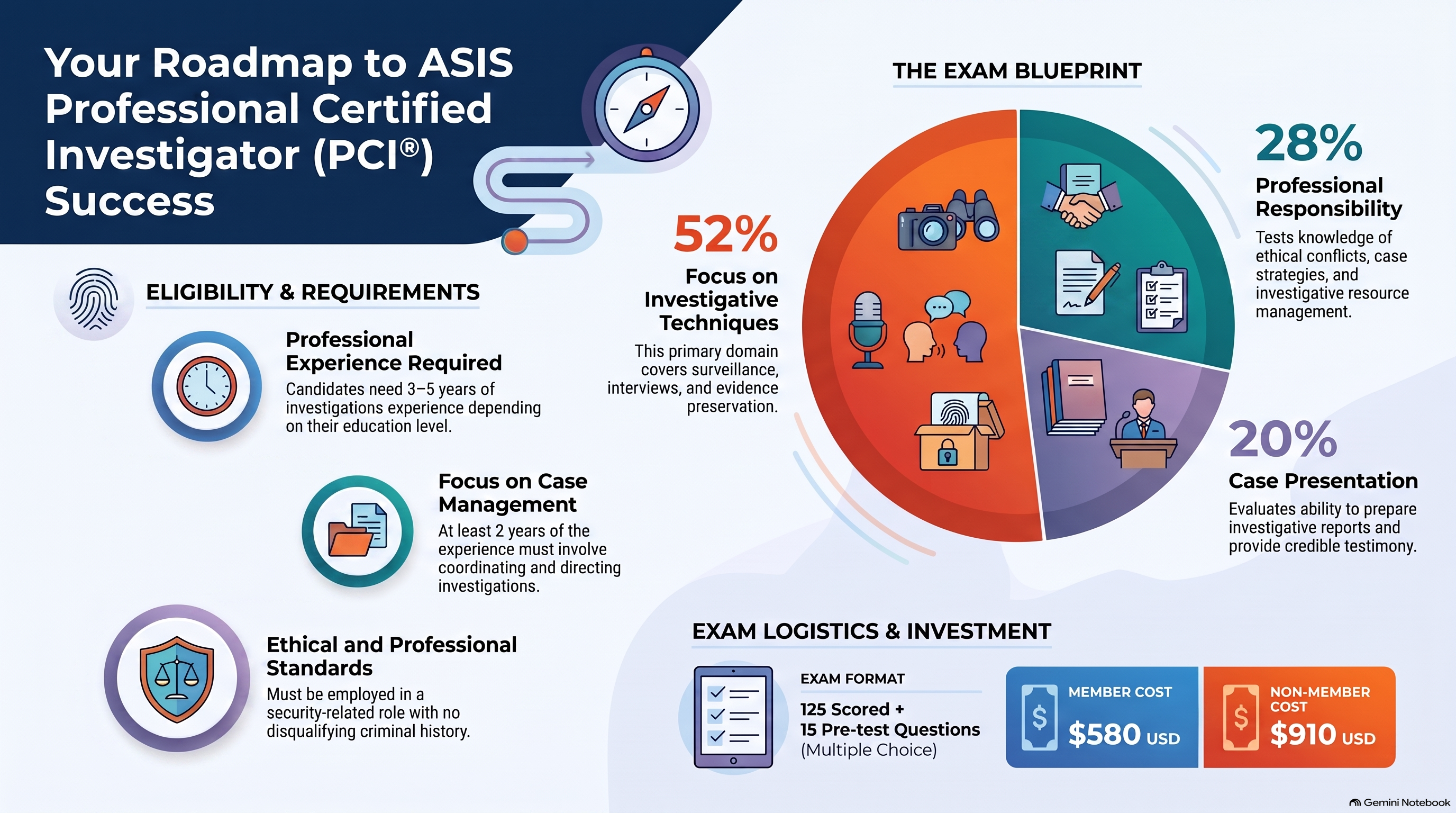
The ASIS PCI certification, formally the Professional Certified Investigator (PCI®), is an experience-based board certification from ASIS International for professionals who manage investigations, collect and assess evidence, conduct interviews and surveillance, and present investigative findings. Candidates need three to five years of investigations experience depending on education, including at least two years in case management. The exam has 140 multiple-choice questions, lasts 2.5 hours, and tests Professional Responsibility, Investigative Techniques and Procedures, and Case Presentation across real-world security investigation scenarios.

What Is the ASIS PCI certification?

The ASIS PCI certification is the Professional Certified Investigator (PCI®) credential offered by ASIS International. It is designed for experienced investigation professionals whose work involves case management, evidence collection, investigative techniques, reporting, and presentation of findings. Unlike a basic investigation course, the credential does not simply prove that you completed training. ASIS board certification combines documented professional experience with a formal examination.The professional certified investigator PCI credential can be particularly relevant for professionals working in:

  • Corporate investigations
  • Fraud and financial investigations
  • Loss prevention
  • Workplace investigations
  • Forensics
  • High-tech and cybercrime investigations
  • Insurance fraud
  • Threat assessment
  • White-collar crime
  • Property and casualty investigations
  • Security and risk functions

One important distinction: ASIS PCI is not PCI DSS certification. If you search for PCI Security Certification, you may see results relating to payment card security. The ASIS credential discussed here certifies an individual investigator's professional competence, not an organization's payment-card compliance.

Professional Certified Investigator PCI Certification: Who Is It For?

The Professional Certified Investigator PCI Certification is best suited to professionals who already investigate cases rather than people trying to enter investigations with no practical experience. Strong candidate profiles include corporate investigators, internal investigators, fraud specialists, loss-prevention professionals, security investigators, compliance investigators and experienced professionals moving from law enforcement or government investigation roles into corporate security. This is also an important distinction when discussing PCI Certification for Individuals: ASIS certifies the qualified professional. It is not a company-level security certification. PCI validates specialized investigation capabilities, including evaluating cases, selecting case-management strategies and gathering information through techniques such as surveillance, interviews and interrogations.

PCI Certification Requirements

The PCI Certification Requirements depend partly on your level of higher education. Every route requires significant investigations experience and at least two years of case-management experience.

Education LevelInvestigations ExperienceIf You Hold APPCase Management
No higher education degree5 years4 yearsAt least 2 years
Bachelor's degree or equivalent4 years3 yearsAt least 2 years
Master's degree or equivalent3 years3 yearsAt least 2 years

Case management involves coordinating and directing an investigation using suitable resources and investigative disciplines, then evaluating the collected information to determine the facts and findings of the case. Applicants must also have relevant professional security experience and satisfy applicable certification conduct and application requirements. A useful eligibility insight is that performing isolated investigative tasks is not necessarily the same as having case-management experience. If you primarily collect evidence or conduct interviews but another person plans, directs and coordinates the complete investigation, verify carefully whether your experience meets the case-management requirement before applying.

ASIS PCI Certification Exam Format

The ASIS PCI Certification examination focuses heavily on applying investigation knowledge rather than simply memorizing definitions.

Exam DetailPCI Information
Total questions140
Scored questions125
Unscored/pretest questions15
Question formatMultiple choice
Exam time2.5 hours
Passing scaled score650 or higher
Testing providerPrometric
Testing optionsTest center or remote proctored
AvailabilityYear-round
LanguagesEnglish and Spanish

Candidates cannot identify which 15 questions are unscored, so every question should be treated as if it contributes to the final result. The examination uses scaled scoring rather than simply calculating a raw percentage of questions answered correctly.

ASIS PCI Exam Domains

The examination covers three major domains:

DomainExam Weight
Professional Responsibility28%
Investigative Techniques and Procedures52%
Case Presentation20%

The weighting immediately shows where preparation effort should go. Investigative Techniques and Procedures represents 52% of the examination, making practical investigative decision-making the largest part of the test.Professional Responsibility accounts for 28%, while Case Presentation represents 20%.

What Do the Domains Actually Test?

Professional Responsibility addresses ethical issues, applicable laws and regulations, case assessment, investigative strategy, risk, resources and professional decision-making.Investigative Techniques and Procedures is the core of the exam. Candidates should be comfortable applying methods connected with information collection, evidence, interviews, surveillance, investigative technologies, forensic concepts, specialized investigations and related procedures.Case Presentation focuses on turning investigative work into defensible findings. This includes preparing reports that support conclusions and communicating investigative results appropriately.That structure explains why experienced investigators may still find the exam challenging. Knowing how your employer conducts investigations is not enough. Candidates must understand professional investigation principles and apply them in different scenarios.

ASIS PCI Certification Cost

The ASIS PCI certification cost varies according to ASIS membership and applicable market classifications.

Candidate CategoryExam Fee
ASIS Member$580
ASIS Member – Emerging Market 1$480
ASIS Member – Emerging Market 2$460
Nonmember$910
Nonmember – Emerging Market 1$720
Nonmember – Emerging Market 2$680

The standard retake fee may also apply if a candidate needs another attempt.Therefore, when calculating the total ASIS PCI Certification Cost, do not consider only the examination fee. Your overall preparation budget may also include:

  • Official reference materials
  • Study guides
  • Practice questions
  • Mock examinations
  • Review courses
  • PCI Certification Training

ASIS membership is not mandatory for earning the credential, although members may receive reduced certification-related pricing. Because certification pricing can change, candidates should always confirm the latest PCI Certification Cost before submitting an application.

How to Get PCI Certification

The How to Get PCI Certification process involves several important steps.

  1. Confirm your eligibility.
    Match your education and investigation experience to the required eligibility pathway.
  2. Verify your case-management experience.
    Make sure you can document at least two years of qualifying case-management work.
  3. Prepare your application information.
    You may need professional history, education documentation, references, supervisor details and other supporting information.
  4. Submit the certification application.
  5. Receive authorization to test.
  6. Schedule your examination.
    Candidates may be able to choose between a testing center and remote-proctored examination.
  7. Prepare using the current examination Body of Knowledge.
  8. Take and pass the PCI examination.
  9. Maintain the certification through continuing professional education.

The PCI Certification Process is therefore more than simply purchasing an exam voucher and booking a test. Experience verification is an important part of certification. Candidates should describe their investigation responsibilities clearly and accurately when submitting their application.

PCI Certification Training: How to Prepare Effectively

Effective PCI Certification Training should be built around scenarios rather than endless memorization. Candidates should begin by reviewing the current Body of Knowledge and evaluating their experience against each exam domain.A focused preparation plan should include:

  • 52% emphASIS on investigative techniques and procedures
  • Scenario-based investigation questions
  • Ethical and legal issue analysis
  • Interview and interrogation concepts
  • Surveillance principles
  • Evidence and information handling
  • Investigation planning
  • Case-management strategies
  • Report preparation
  • Presentation of investigative findings
  • Timed mock examinations
  • Review of weak domains after practice tests

A common preparation mistake is spending equal study time on every domain.The examination weights are 28%, 52% and 20%, which means candidates should place additional preparation emphasis on Investigative Techniques and Procedures while maintaining adequate knowledge across all three areas. Candidates should also practice answering questions that ask for the BEST, MOST appropriate, FIRST, or PRIMARY investigative action.These questions test judgment rather than simple recall.

ASIS PCI vs Other Security Certifications

People searching ASIS PCI, PCI certification ASIS, or similar phrases sometimes confuse PCI with broader cybersecurity or security-management credentials.PCI has a very specific specialization: professional investigations.It is most relevant when your work involves:

  • Managing investigations
  • Conducting interviews
  • Collecting evidence
  • Evaluating investigative information
  • Managing investigative resources
  • Developing case strategies
  • Preparing investigative reports
  • Presenting findings

If your role primarily involves enterprise security leadership, another management-focused security credential may be more appropriate. If your work is mainly focused on physical-security assessments and protection systems, a physical-security credential may align better. PCI provides the strongest alignment when professional investigations form a significant part of your job responsibilities.

Benefits of ASIS PCI Certification

Earning the ASIS PCI Certification can help experienced professionals demonstrate specialized knowledge in professional investigations.Potential benefits include:

  • Professional credibility in investigation-related roles
  • Formal validation of investigative experience
  • Recognition of case-management skills
  • Stronger professional positioning
  • Greater credibility when handling complex investigations
  • Validation of investigative reporting skills
  • Improved understanding of professional standards
  • Career development opportunities
  • Broader knowledge beyond employer-specific procedures

For experienced investigators, the certification can help demonstrate that their abilities extend beyond one organization, industry or internal investigation methodology.

Is the ASIS PCI Certification Worth It?

The credential can be valuable for experienced investigation professionals who want formal third-party recognition of their expertise. Its value is strongest when the certification matches the work you already perform.For example, a corporate fraud investigator who manages complex investigations can use PCI to validate a broader professional skill set covering:

  • Investigation planning
  • Information gathering
  • Professional responsibility
  • Investigative techniques
  • Case management
  • Evidence handling
  • Reporting
  • Presentation of findings

The certification is less suitable as an entry-level credential because the eligibility requirements are deliberately built around professional experience. Someone with no investigation background should first focus on developing practical investigation knowledge and professional experience before pursuing PCI.

Your Next Step Toward PCI Certification

Start by comparing your education, total investigation experience and two years of case-management experience against the PCI eligibility requirements.Then evaluate your preparation against the examination weighting:

  • Professional Responsibility – 28%
  • Investigative Techniques and Procedures – 52%
  • Case Presentation – 20%

If you already meet the experience requirements, move from general reading to structured, scenario-driven preparation. The ASIS PCI certification is designed to test how effectively you apply investigative judgment, manage cases and communicate findings—not simply how many investigation terms you can memorize.

11Aug

OSP Certification, officially known as the BICSI Outside Plant Designer™ (OSP) credential, validates a professional’s ability to design and integrate outside plant telecommunications infrastructure.


OSP Certification, officially known as the BICSI Outside Plant Designer™ (OSP) credential, validates a professional’s ability to design and integrate outside plant telecommunications infrastructure. It covers aerial, underground, and direct-buried systems, route planning, cabling, pathways, grounding, bonding, project planning, and cost considerations. Candidates can qualify through a current RCDD credential or relevant OSP experience plus documented education. The current exam contains 100 questions, allows 2 hours, and is delivered through Pearson VUE.

What Is OSP Certification?

If you are researching what is osp certification, it is important to distinguish BICSI's credential from general telecommunications training.The BICSI Outside Plant Designer™ credential is intended for ICT professionals who design communications infrastructure located outside buildings. BICSI describes the credential as recognition for people with extensive knowledge and experience in designing new OSP systems and integrating existing infrastructure.Outside plant projects can include infrastructure connecting buildings, campuses, facilities, telecommunications networks, and other locations through:

  • Underground pathways
  • Direct-buried cabling
  • Aerial cable systems
  • Optical fiber infrastructure
  • Copper telecommunications cabling
  • Poles, ducts, conduits, maintenance holes, and pathways
  • Grounding and bonding systems
  • Rights-of-way and route planning
  • Existing infrastructure integration

BICSI identifies its OSP credential as a major industry designation for aerial and direct-burial plant expertise.For experienced designers, the value is not simply knowing how cable is installed. The real skill is making technically defensible design decisions while balancing capacity, physical environment, pathway constraints, standards, expansion requirements, constructability, reliability, and cost.

OSP Certification Exam at a Glance

Here is a simple overview of the current osp certification requirements and examination structure.

OSP Certification DetailCurrent Information
CredentialBICSI Outside Plant Designer™ (OSP)
Certification BodyBICSI
Exam Questions100 questions
Exam Duration2 hours
Delivery MethodComputer-based testing
Testing ProviderPearson VUE
Eligibility Option 1Hold a current RCDD credential
Eligibility Option 22 years of applicable OSP experience + required education
Required Education under Option 2Minimum 32 documented hours
Credential Cycle3 years
Renewal Requirement24 CECs during the three-year cycle

BICSI confirms the 100-question, two-hour examination, while its certification handbook states that OSP credential holders must earn 24 continuing education credits within the three-year credential cycle.

BICSI OSP Designer Certification Requirements

The bicsi osp designer certification requirements are especially important because professional experience is part of the qualification process.BICSI currently provides two main eligibility paths.

Option 1: Current RCDD Credential

You can qualify to apply for the OSP certification examination if you hold a current BICSI RCDD credential.This route makes sense because an RCDD already demonstrates broader ICT infrastructure design knowledge.

Option 2: OSP Experience and Education

Candidates without the qualifying RCDD credential can meet the bicsi osp designer certification eligibility requirements experience pathway through:

  • Two years of verifiable full-time-equivalent experience involving OSP design and/or installation
  • At least 32 hours of documented continuing education in OSP design and/or installation

The education may include qualifying BICSI education and other documented industry training that meets BICSI's requirements.This is an important distinction: OSP is designed for professionals with practical exposure, not candidates relying entirely on memorized textbook concepts.

What Does an OSP Designer Actually Need to Know?

A strong osp design program should go beyond examination terminology and develop the decision-making skills used during actual outside plant projects.An OSP designer may need to evaluate:

Route Selection

A route that appears shortest on a drawing may not be the best engineering choice.Designers need to consider:

  • Existing utilities
  • Physical obstructions
  • Easements and rights-of-way
  • Maintenance accessibility
  • Environmental exposure
  • Future expansion
  • Installation cost
  • Network resilience

Underground Infrastructure

Underground design can involve conduit systems, maintenance holes, handholes, pathway capacity, cable pulling considerations, separation requirements, and future growth.

Direct-Buried Infrastructure

Direct burial removes some pathway infrastructure but introduces different concerns involving soil conditions, cable protection, depth, route marking, environmental risk, and future maintenance.

Aerial Infrastructure

Aerial OSP work can require knowledge of poles, clearances, support structures, guying, loading, attachment locations, cable placement, and environmental conditions.BICSI's official OSP102 Applied Outside Plant Design course specifically covers design techniques for underground, direct-buried, and aerial applications.

What Should OSP Designer Training Cover?

Effective osp designer training should prepare professionals to solve design problems rather than memorize isolated definitions.A useful osp design training plan should include:

  1. OSP infrastructure fundamentals
  2. Site and pre-design assessment
  3. Codes, standards, and regulations
  4. Route selection
  5. Underground pathway design
  6. Direct-buried plant design
  7. Aerial plant design
  8. Cable and media selection
  9. Grounding and bonding
  10. Electrical protection
  11. Rights-of-way
  12. Existing infrastructure assessment
  13. Planning and documentation
  14. Cost estimating
  15. Scenario-based design practice

BICSI's introductory OSP curriculum specifically addresses codes and standards, pre-job assessments, underground pathways, direct-buried pathways, aerial structures, grounding and bonding, electrical protection, and rights-of-way.That gives candidates a useful clue about how to prepare: understand why a design choice is correct, not only what the technical term means.

OSP Training Certification vs OSP Credential

Candidates sometimes treat osp training certification and the OSP credential as interchangeable. They are not.Completing an OSP course can build knowledge and may provide documented education, but the BICSI OSP certification requires meeting eligibility requirements and successfully completing the credentialing examination.BICSI's OSP102 course is recommended for professionals preparing for the credential, but the certification exam is a separate credentialing process.So when comparing an osp certificate from a training provider with the BICSI credential, check exactly what is being awarded.A course completion certificate proves training participation. The BICSI OSP designation represents achievement of BICSI's professional credential requirements.

How to Prepare for BICSI OSP Certification

A disciplined preparation strategy is more effective than reading hundreds of pages without a plan.

1. Start With the Exam Blueprint

Use the official blueprint to identify how BICSI organizes the tested knowledge. BICSI's published OSP exam content outline begins with areas such as pre-design preparation and assigns examination weighting to major areas.

2. Study the OSPDRM

The Outside Plant Design Reference Manual (OSPDRM), 6th Edition is an official BICSI reference for OSP design and examination preparation. BICSI states that the manual, together with OSP education, serves as a detailed study reference for the OSP design exam.

3. Connect Theory to Real Designs

Do not study underground, direct-buried, and aerial systems as isolated chapters.For each scenario, ask:

  • Which route is technically practical?
  • Which pathway protects the infrastructure?
  • What environmental risks exist?
  • What standards or regulations affect the design?
  • How will maintenance crews access the plant?
  • What capacity will future expansion require?
  • What design creates unnecessary cost?

This type of reasoning is much closer to professional design work.

4. Use Scenario-Based Practice Questions

Practice should test judgment.A good question should force you to compare several technically plausible choices and determine the best design decision based on project conditions.

5. Review Weak Areas Separately

Do not repeatedly study topics you already understand.Track mistakes by category, such as:

  • Route planning
  • Aerial systems
  • Underground systems
  • Direct burial
  • Cable selection
  • Grounding and bonding
  • Protection
  • Documentation
  • Estimating

Then build targeted revision sessions.

OSP Certification Cost

BICSI's current published OSP certification handbook lists the examination application fee at $510 for BICSI members and $725 for nonmembers, including the first Pearson VUE exam attempt. Published retest pricing is $230 for members and $355 for nonmembers.BICSI's online store also currently lists the standard OSP exam fee at $725, consistent with the nonmember price.Training, manuals, membership, and other preparation resources can add separate costs.Because pricing can change, candidates should verify current BICSI fees before registering.

BICSI OSP Certification and RCDD: How Are They Related?

The terms rcdd osp certification and bicsi rcdd/osp certification are sometimes searched together, but these are separate professional credentials.RCDD focuses broadly on ICT infrastructure design, while OSP concentrates more deeply on outside plant systems.There is still a strong connection between them: holding a current RCDD is one of BICSI's accepted eligibility routes for the OSP examination.The relationship also works strategically in the other direction. BICSI currently recognizes an OSP credential as one qualification that can contribute to certain RCDD eligibility pathways when combined with required ICT design experience.For professionals responsible for both building distribution and campus or external infrastructure, holding both credentials can demonstrate a broader design capability.

Is OSP Design Certification Worth Pursuing?

An osp design certification is most relevant when your work involves telecommunications pathways beyond the building entrance.It can be especially useful for:

  • Outside plant designers
  • Telecommunications engineers
  • ICT consultants
  • Network infrastructure designers
  • Fiber infrastructure professionals
  • Utility communications specialists
  • Campus network designers
  • RCDDs expanding into OSP
  • Project professionals working with external ICT infrastructure

BICSI notes that many organizations require the OSP credential for design or installation personnel working on outside plant projects.The strongest reason to pursue it, however, is specialization. Designing an OSP system requires decisions that can affect construction cost, network reliability, maintenance effort, expansion capability, and infrastructure life cycle.A poorly selected pathway can remain an operational problem for decades. A well-designed route can support multiple technology generations.

OSP Certifications: What Makes BICSI Different?

There may be multiple training-based osp certifications in the market, but the BICSI credential is built around documented professional eligibility, formal examination, and continuing professional development.Credential holders must maintain the designation rather than treating certification as a one-time achievement. BICSI states that the OSP credential remains valid for a three-year cycle and requires 24 CECs for renewal.That continuing-education requirement matters in a field affected by evolving fiber technologies, construction methods, standards, materials, deployment practices, and network capacity requirements.

Your Next Step Toward OSP Certification

Treat OSP Certification as a professional design credential, not simply another exam.First confirm that you meet BICSI's eligibility requirements. Then use the official exam blueprint and OSPDRM, strengthen your understanding of underground, aerial, and direct-buried infrastructure, and practice applying those concepts to realistic design scenarios.For candidates who need a structured learning path, a focused osp designer training program can help organize the technical material, identify weak design areas, and turn OSP theory into exam-ready problem-solving skills.

OSP certifications usually refers to the BICSI Outside Plant Designer™ (OSP) credential, which validates a professional’s ability to design outside plant ICT infrastructure. It covers route planning, underground, direct-buried and aerial pathways, media selection, grounding and bonding, rights-of-way, estimating, and project coordination. Candidates qualify through a current RCDD credential or documented OSP experience plus continuing education. The current exam has 100 questions, allows two hours, and is delivered through Pearson VUE. Certification must then be maintained through BICSI recertification requirements.

What Are OSP Certifications?

For professionals asking what is OSP certification, OSP stands for Outside Plant, referring to telecommunications and ICT infrastructure installed outside buildings and extending between facilities, campuses, utility routes, streets, and other external environments.TheBICSI OSP certification is specifically the BICSI Outside Plant Designer™ (OSP) credential. BICSI describes it as a leading designation focused on aerial and direct-burial outside plant work. An OSP designer may work with:

  • Fiber-optic and copper cable routes
  • Underground duct and conduit systems
  • Handholes, maintenance holes, and pull points
  • Direct-buried communications infrastructure
  • Aerial cable routes and support structures
  • Campus telecommunications systems
  • Grounding, bonding, and electrical protection
  • Rights-of-way and route restrictions
  • Cost estimates and project planning

The important distinction is that OSP work is not simply about selecting cable. A competent designer must consider route viability, physical protection, capacity, maintainability, environmental conditions, codes, constructability, cost, and future expansion as parts of one design.

Why OSP Certifications Matter for ICT Professionals

A strong OSP design certification demonstrates expertise in an area that sits between telecommunications engineering, infrastructure design, construction, utility coordination, and project management. BICSI states that many organizations require the OSP credential for personnel involved in outside plant design and installation projects. The credential can be particularly relevant for:

  • Outside plant designers
  • Telecommunications engineers
  • Fiber infrastructure designers
  • ICT consultants
  • Utility telecommunications professionals
  • Network infrastructure engineers
  • Campus infrastructure designers
  • Project managers working on OSP deployments
  • RCDDs expanding into outside plant specialization

The real value comes from being able to make defensible design decisions. Employers and clients need more than someone who knows what a conduit, splice closure, or fiber cable is. They need someone who can determine where infrastructure should run, how it should be protected, what installation method fits the environment, and what the project is likely to cost.

BICSI OSP Designer Certification Requirements

The current BICSI OSP designer certification requirements provide two eligibility routes.

Eligibility PathCurrent Requirement
Option 1Hold a current RCDD® credential
Option 2Have 2 years of verifiable full-time equivalent experience in OSP design and/or installation, plus at least 32 hours of documented continuing education in OSP-related subjects

BICSI publishes these eligibility routes on its official OSP certification information. People searching for BICSI OSP designer certification eligibility requirements experience should pay particular attention to the word verifiable. Practical experience should be documented accurately rather than treated as a general statement that you have worked in networking. OSP experience can involve design or installation activities associated with real outside plant infrastructure.

Experience matters more than job title

A job title such as Network Engineer or Telecom Engineer does not automatically prove OSP design capability.When preparing an application, identify work where you actually participated in areas such as:

  • Route surveys
  • Pathway selection
  • Fiber or copper route planning
  • Aerial or underground infrastructure
  • Construction documentation
  • Cable calculations
  • Cost estimates
  • Rights-of-way
  • Installation coordination

This makes your experience easier to explain and document.

BICSI OSP Exam Format

The BICSI OSP designer certification requires candidates to pass a computer-based examination.

Exam DetailCurrent Information
Questions100
Exam Time2 hours
DeliveryPearson VUE computer-based testing
Member Application Fee$510
Nonmember Application Fee$725
First AttemptIncluded with application fee

BICSI currently lists these exam details and fees on its OSP credential information. Fees can change, so candidates should confirm pricing with BICSI before submitting an application.

What makes the exam challenging?

The difficulty is not simply memorizing definitions. OSP designers regularly face situations where several solutions are technically possible, but only one makes the most sense after considering route limitations, cable type, installation method, safety, regulations, cost, maintenance, and future capacity. That is why strong preparation should focus on design judgment rather than isolated facts.

What Should OSP Designer Training Cover?

Effective OSP designer training should reflect the decisions made during real outside plant projects. BICSI's official OSP102 Applied Outside Plant Design course covers campus OSP projects and design techniques involving underground, direct-buried, and aerial cable plant applications. It also uses design scenarios involving route design, media selection, planning, and cost estimation. A serious OSP design training plan should therefore cover:

  1. Outside Plant Fundamentals
    Understand OSP infrastructure components and how systems connect facilities.
  2. Route Planning
    Evaluate possible routes based on physical conditions, accessibility, risk, cost, and future requirements.
  3. Underground Infrastructure
    Understand pathways, spaces, conduit systems, pulling considerations, and access points.
  4. Direct-Buried Infrastructure
    Learn where direct burial may be appropriate and what protection and planning issues affect the design.
  5. Aerial Plant Design
    Understand support structures, clearances, pathways, and deployment considerations.
  6. Media Selection
    Select appropriate telecommunications media based on distance, capacity, environment, and application requirements.
  7. Grounding and Bonding
    Apply appropriate grounding, bonding, and electrical protection principles.
  8. Cost Estimation
    Translate the technical design into materials, labor considerations, and realistic project costs.
  9. Codes and Rights-of-Way
    Understand the effect of regulations, standards, public property, private property, and route permissions.

These subjects are also reflected in BICSI's OSP education materials.

OSP Design Program vs Certification

An OSP design program teaches knowledge and design methods. The professional credential verifies that a candidate has satisfied BICSI's eligibility requirements and passed the certification examination. That distinction matters. Completing a course does not automatically make someone OSP-certified. Similarly, an OSP training certification offered by a training provider should not be confused with the official BICSI OSP credential unless the provider is specifically describing the BICSI certification pathway. BICSI's OSP102 course is recommended for professionals preparing for the OSP credential, but the exam application is a separate process.

OSP102 Applied Outside Plant Design

BICSI's official OSP102 course is one of the most directly aligned OSP design program options for professionals preparing for this field.The current course provides 35 continuing education credits (CECs) and covers areas including:

  • OSP infrastructure components
  • Pathways and spaces
  • Route design
  • Planning
  • Grounding and bonding
  • Underground systems
  • Direct-buried systems
  • Aerial routes
  • Cost estimation

BICSI states that the course is intended for OSP professionals and for BICSI TECH, RTPM, and RCDD credential holders who want to advance into Outside Plant design. An effective independent OSP design training plan should mirror these practical design areas even when a candidate chooses a different preparation route.

OSP Certification vs RCDD

The terms RCDD OSP certification and BICSI RCDD/OSP certification sometimes appear together, but they represent different BICSI credentials.

OSPRCDD
Specialized in Outside Plant designBroader ICT and telecommunications distribution design credential
Strong emphasis on aerial, underground, and direct-buried infrastructureCovers broader telecommunications distribution systems
Current RCDD holders can qualify for OSP through eligibility Option 1Current OSP holders can help satisfy one RCDD eligibility path when combined with required ICT design experience
Best suited to dedicated OSP workBest suited to broader ICT design responsibility

BICSI describes the RCDD as a credential demonstrating mastery of ICT and telecommunications distribution system design. The credentials therefore complement each other rather than serving as simple replacements. BICSI also lists a current OSP credential among the certifications that can contribute to one RCDD eligibility route when the required design experience is also met.

How to Earn the OSP Certificate

The path to an OSP certificate can be organized into a straightforward process:

  1. Check your eligibility.
  2. Document relevant OSP experience.
  3. Complete required education if using the experience-based route.
  4. Review current BICSI OSP resources.
  5. Build a structured study plan.
  6. Practice scenario-based design decisions.
  7. Submit the OSP exam application and résumé.
  8. Schedule the exam through Pearson VUE after approval.
  9. Pass the certification exam.
  10. Maintain the credential through continuing education.

BICSI requires an online OSP exam application and current résumé as part of the application process.

Maintaining Your OSP Certification

Earning the credential is not the end of the process. BICSI requires OSP credential holders to earn 24 continuing education credits within a three-year certification cycle for recertification. This requirement matters because outside plant design continues to change as fiber deployment methods, standards, construction practices, materials, and project requirements evolve. Professionals should avoid waiting until the final months of the cycle to think about renewal. Track approved CEC activity throughout the three-year period and maintain documentation.

How to Prepare More Effectively

Candidates often make one mistake: studying OSP as a collection of individual components. A stronger approach is to think like a designer.For every topic, ask:

  • What problem is the design solving?
  • What environmental conditions affect the route?
  • Which pathway method is appropriate?
  • What happens if capacity increases later?
  • How will technicians access the infrastructure?
  • What safety or regulatory restrictions apply?
  • How does the design affect construction cost?

That approach turns memorized knowledge into applied design reasoning. The official Outside Plant Design Reference Manual (OSPDRM), 6th Edition is also part of BICSI's current OSP educational resources.

Your Next Step Toward OSP Certifications

Before investing heavily in preparation, confirm which eligibility route applies to you. Current RCDD holders have a direct eligibility path, while experienced OSP professionals should document their two years of relevant experience and the required 32 hours of continuing education. Then build your preparation around actual OSP design decisions—not only terminology. Focus on route planning, aerial and underground infrastructure, direct burial, media selection, grounding and bonding, rights-of-way, planning, and cost estimation. That is the difference between preparing merely to answer exam questions and developing the design judgment that makes OSP certifications valuable in real ICT infrastructure projects.


10Aug

The cia Certification is the Certified Internal Auditor® credential issued by The Institute of Internal Auditors (The IIA).

The cia Certification is the Certified Internal Auditor® credential issued by The Institute of Internal Auditors (The IIA). It validates professional capability in internal audit fundamentals, engagement work, and audit-function management. The traditional pathway requires three exams, approved education or an active IAP route, and relevant experience based on education level. Candidates generally have three years to complete program requirements. Current U.S./select-market fees total $990 for members or $1,515 for non-members, before applicable taxes or membership dues, as of 2026.

What Is cia Certification?

The cia certification is the professional credential for becoming a Certified Internal Auditor. It is awarded by the Institute of Internal Auditors, commonly known as The IIA, and focuses specifically on the knowledge and judgment required to perform and manage internal audit work.The IIA describes the CIA as the only globally recognized internal audit certification and reports more than 220,000 CIA professionals across 170 countries.certified internal auditor certification is particularly relevant for professionals working in:

  • Internal auditing

  • Governance and internal control

  • Enterprise risk management

  • Compliance

  • External audit

  • Quality assurance

  • Audit and assessment functions

One important distinction is that CIA is not simply an accounting credential. Modern cia internal audit work requires professionals to understand risk, governance, controls, evidence, stakeholder expectations, audit planning, engagement execution, and communication.

cia Certification Exam: Current 2026 Structure

The traditional cia certification exam consists of three separate multiple-choice examinations. Candidates do not have to take the parts in numerical order.

CIA Exam PartCurrent FocusQuestionsTimeMember FeeNon-Member Fee
Part 1Internal Audit Fundamentals125150 minutes$310$445
Part 2Internal Audit Engagement100120 minutes$280$415
Part 3Internal Audit Function100120 minutes$280$415

The traditional pathway therefore contains 325 questions across 390 minutes of testing. The IIA identifies the three current content areas as Internal Audit Fundamentals, Internal Audit Engagement, and Internal Audit Function.For anyone researching the certified internal auditor exam, this three-part structure matters because each part demands a different preparation strategy.

Part 1: Internal Audit Fundamentals

Part 1 establishes the professional foundation. Candidates need to understand how internal auditing operates within an organization, including governance, independence, professional standards, risk, controls, and the responsibilities of the internal audit function.

Part 2: Internal Audit Engagement

Part 2 moves closer to actual engagement execution. Preparation should emphasize how auditors plan engagements, collect and evaluate information, document work, exercise professional judgment, and develop supportable findings.

Part 3: Internal Audit Function

Part 3 looks more broadly at managing and delivering an effective internal audit function, including audit planning, operations, quality, engagement results, stakeholder communication, and monitoring.The current CIA syllabus is aligned with modern internal audit practice and The IIA provides official syllabi for all three parts.

cia Certification Requirements and Eligibility

Understanding cia certification requirements before purchasing an exam is essential because passing the tests alone does not automatically satisfy every certification requirement.The current cia certification eligibility structure is largely determined by education and relevant professional experience.

Entry BackgroundExperience Requirement
Master’s degree or equivalent/higher1 year
Bachelor’s degree or equivalent2 years
Active IAP without qualifying degree5 years*

*For the active IAP pathway without a qualifying degree, two of the five required years must be within the previous three years. Degree holders using the IAP route follow the applicable education-based experience requirement.Relevant experience can come from internal audit, quality assurance, risk management, audit/assessment disciplines, compliance, external audit, or internal control.These are the core certified internal auditor requirements candidates should evaluate before applying.For candidates specifically researching certified internal auditor certification requirements, another useful rule is that professional experience does not necessarily have to be completed before sitting for the exams. Candidates with qualifying education can take the examinations before satisfying their full experience requirement, but all program requirements must be completed within the applicable program period.

What if You Do Not Have a Degree?

The current pathway is more flexible than many candidates assume.Students and professionals without a qualifying degree can begin through the Internal Audit Practitioner (IAP) route. The IAP uses CIA Part 1, and an active IAP holder who later enters the CIA program can receive a waiver for Part 1.That makes the answer to questions about requirements for cia certification dependent on your academic and professional background rather than a single universal requirement.

cia Certification Cost in 2026

The published cia certification cost varies according to IIA membership status and location.Current pricing published by The IIA is:

FeeIIA MemberNon-Member
CIA Application$120$240
Part 1$310$445
Part 2$280$415
Part 3$280$415
Total$990$1,515

Therefore, the basic cost of cia certification under the traditional three-exam pathway is $990 at member rates or $1,515 at non-member rates based on current listed pricing.The difference is significant: member pricing reduces the listed application-and-exam total by $525. However, candidates should also consider their applicable membership dues before deciding which route is financially better.If you are specifically comparing cia exam cost, remember that the application fee is separate from the registration fee for each examination.Similarly, searches for certified internal auditor certification costcertified internal auditor cost, or certified internal auditor exam cost should distinguish between the price of one exam and the complete certification process.The IIA notes that these prices apply in the United States, Canada, and select markets. Local National Institutes may use different pricing, and applicable taxes can also change the final amount.

How to Get the iia CIA Certification

The application process for an iia cia certification is handled through The IIA's Certification Candidate Management System, or CCMS.The practical process is:

  1. Confirm your eligibility pathway.

  2. Gather required education documentation and government-issued identification.

  3. Create or access your CCMS account.

  4. Submit your CIA application and pay the application fee.

  5. Wait for document and application approval.

  6. Register for each required cia exam.

  7. Schedule and complete the examinations.

  8. Submit or complete your experience verification.

  9. Receive the CIA designation after all requirements are satisfied.

Candidates accepted into the traditional program must pass all three exam parts and complete the program requirements within three years.

How Should You Approach cia Exam Preparation?

Effective cia exam preparation should focus less on memorizing isolated definitions and more on applying internal audit principles to realistic decisions.A strong study sequence is:

  • Learn the current syllabus before selecting study materials.

  • Build conceptual understanding before intensive question practice.

  • Study one exam part as a separate project.

  • Practice scenario-based questions regularly.

  • Review why incorrect answers are wrong.

  • Track weak topics instead of repeatedly studying strong areas.

  • Run timed practice sessions before scheduling the examination.

The IIA provides current syllabi, sample questions, and practice resources, including practice questions based on retired examination items. Study materials are not automatically included with standard CIA application or exam registration fees.A structured certified internal auditor exam preparation plan should therefore combine syllabus coverage, question practice, review, and exam-time management.

cia Certification Training: Self-Study or Instructor-Led?

The right cia certification training format depends on your audit experience.Experienced auditors may be comfortable with a self-directed cia certification course, while professionals moving from accounting, finance, compliance, IT audit, or risk management may benefit from instructor guidance that connects exam concepts with internal audit scenarios.When assessing a certified internal auditor course, look for:

  • Alignment with the current CIA syllabus

  • Part-specific lessons

  • Scenario-based practice questions

  • Detailed answer explanations

  • Mock examinations

  • Performance analytics

  • Weak-area revision

  • Access to updated materials

certified internal auditor online course can be particularly useful for working professionals because preparation can be scheduled around professional responsibilities.However, the phrase cia certification online should not automatically be interpreted as “take every CIA exam from home.” The IIA directs candidates to its testing and Pearson VUE resources for current exam-delivery procedures, so candidates should verify available testing options when scheduling.

Who Should Pursue the CIA?

The credential has strong relevance beyond professionals whose job title literally says “internal auditor.”cia certified internal auditor pathway can make sense for:

  • Internal auditors seeking progression toward senior or management roles

  • External auditors moving into corporate assurance

  • Risk and compliance professionals

  • Internal-control specialists

  • Finance professionals moving into assurance

  • IT auditors expanding into broader enterprise audit work

  • Audit managers preparing for leadership responsibilities

The value of an iia certified internal auditor is the breadth of professional judgment the credential develops. The exams connect governance, risk, control, engagement execution, audit-function management, quality, and communication rather than testing one narrow technical discipline.That makes this institute of internal auditors certification useful for professionals who want their knowledge to extend from performing individual audit procedures to understanding how the entire internal audit function supports an organization.

Is the CIA Worth Pursuing?

For someone planning a long-term career in internal audit, risk, governance, assurance, or controls, CIA is one of the most directly aligned professional credentials available. The IIA positions it as its globally recognized internal audit designation, with holders operating across 170 countries.The bigger benefit is not simply adding three letters after your name. Proper preparation forces candidates to understand why an audit procedure is appropriate, how evidence supports conclusions, where internal audit independence can be compromised, and how findings should influence organizational action.That distinction matters in senior audit roles, where professional judgment is usually more valuable than mechanical knowledge.

Maintaining Your Certified Internal Auditor Credential

Earning the designation is not the final administrative requirement. Active practicing CIA holders must complete 40 CPE hours annually and renew their certification each year. The IIA's annual renewal period runs from October 1 through December 31.Maintaining your credential therefore requires an ongoing professional-development plan rather than treating the certification as a one-time examination achievement.

Your Next Step: Build a Part-by-Part CIA Plan

Start by checking your certified internal auditor eligibility, calculating your complete expected fees, and downloading the current official syllabus before buying training materials.Then treat each exam part as a separate objective: understand the syllabus, build your knowledge base, practice application-oriented questions, measure weak areas, and schedule the examination only when your performance is consistent.The strongest preparation strategy is not studying the greatest number of hours. It is knowing exactly what the CIA exam expects you to decide as an internal auditor—and being able to make that decision under exam pressure.


The psp certification is the Physical Security Professional (PSP®) board certification from ASIS International for experienced physical security practitioners. It validates competence in security assessment, system design and integration, and implementation of physical security measures. The current exam contains 125 scored questions plus 15 unscored pretest questions, allows 2.5 hours, and covers three domains. Candidates generally need three to five years of relevant experience, depending on education and whether they already hold the APP credential.

What Is PSP Certification?

If you are asking what psp certification is, it is a specialized board certification for professionals who assess physical-security risk, select and design protection systems, and manage the implementation of security measures.The official physical security professional (psp) credential is administered by ASIS International. It is designed for practitioners whose responsibilities go beyond guarding a facility. PSP candidates are expected to understand risk assessment, system requirements, access control, video surveillance, intrusion detection, protective design, procurement, installation, commissioning, and security-program evaluation.For anyone researching psp meaning in security, psp meaning security, psp security meaning, or what is psp in security, PSP stands for Physical Security Professional in the ASIS certification context.A related search such as psp course full form can be misleading because PSP is not the name of a training course. It is the professional certification designation itself.The psp designation is therefore different from a simple attendance-based psp certificate. Candidates must satisfy eligibility requirements and pass a formal certification examination before using the credential. ASIS describes its board certifications as evidence of demonstrated professional knowledge and competency.

ASIS PSP Certification Overview for 2026

The following asis psp certification overview captures the major details candidates should know before applying.

PSP DetailCurrent Information
Certification bodyASIS International
Full namePhysical Security Professional (PSP®)
Exam formatMultiple choice
Total questions140
Scored questions125
Unscored pretest questions15
Exam time2.5 hours
Exam domains3
Experience requirementApproximately 3–5 years, depending on education/APP status
Member exam fee$580
Nonmember exam fee$910
Testing optionsPrometric testing center or remote proctoring
Recertification cycleEvery 3 years
CPE requirement60 CPE hours per cycle

ASIS confirms that the asis psp exam has four answer choices per question, with one correct response. Both unanswered and incorrectly answered questions count against the candidate's result.This makes psp testing less about recognizing isolated definitions and more about selecting the most defensible security decision under realistic constraints.

PSP Certification Requirements: Who Is Eligible?

The psp certification requirements are based primarily on physical-security experience and education.ASIS currently specifies the following pathways.

Without a Higher-Education Degree

Candidates need:

  • Five years of physical security experience, or
  • Four years if they already hold the ASIS APP certification.

With a Master's Degree

Candidates need:

  • A master's degree or international equivalent from an accredited institution, and
  • Three years of physical security experience.

With a Bachelor's Degree

Candidates need:

  • A bachelor's degree or international equivalent from an accredited institution, and
  • Four years of physical security experience, or
  • Three years if they already hold APP.

These are the core asis psp certification requirements and psp requirements, but eligibility does not stop with years of experience.Applicants must also be working full time in a security-related position, meet ASIS's professional-conduct requirements, and agree to follow certification policies and the ASIS Certification Code of Conduct. In practical terms, the psp qualification is aimed at established practitioners rather than complete beginners.

How to Get PSP Certification

Candidates wondering how to get psp certification can think of the process as five stages.

  1. Confirm eligibility. Match your education and physical-security experience against the official requirements.
  2. Document your experience. Prepare a résumé or CV showing work that aligns with the PSP domains.
  3. Prepare your application. ASIS requests applicable educational documentation, three professional references, supervisor information, and payment.
  4. Prepare for the exam. Study the official Body of Knowledge and practice applying physical-security principles to scenarios.
  5. Schedule and take the exam. Approved candidates can test through Prometric according to ASIS scheduling options.

Your résumé deserves particular attention. A generic security job description does not communicate expertise as effectively as experience tied to assessments, system design, integration, procurement, implementation, commissioning, or security-program management.

PSP Exam Domains and Coverage

Understanding psp coverage should drive your study strategy.The current examination covers three weighted domains.

DomainExam WeightWhat You Need to Understand
Physical Security Assessment34%Assets, threats, hazards, vulnerabilities, risk analysis and countermeasures
Application, Design, and Integration of Physical Security Systems35%Requirements, protective measures, electronic systems, CPTED, system design and integration
Implementation of Physical Security Measures31%Bidding, procurement, installation, commissioning, personnel and lifecycle evaluation

Domain 1: Physical Security Assessment – 34%

The first domain tests whether you can build and execute a defensible assessment.Expect concepts involving:

  • Critical asset identification
  • Qualitative and quantitative assessment
  • Threat and hazard evaluation
  • Vulnerability assessment
  • Building plans and environmental conditions
  • Risk-analysis methods
  • Countermeasure selection
  • Cost-benefit analysis
  • Legal and regulatory considerations

A strong physical security professional psp candidate should be able to connect assets, threats and vulnerabilities rather than evaluating each in isolation.

Domain 2: Application, Design, and Integration – 35%

This is the largest domain.It covers design constraints, performance requirements, risk-informed system design and the selection of appropriate countermeasures.Candidates may encounter concepts involving:

  • Barriers and structural protection
  • CPTED
  • Access control
  • Video surveillance
  • Intrusion detection
  • Emergency communication
  • Monitoring systems
  • Power and backup power
  • Network infrastructure
  • Signal transmission
  • Security personnel
  • Project documentation
  • System integration

The key distinction is between knowing what a security technology does and determining whether it meets a defined operational requirement.

Domain 3: Implementation of Physical Security Measures – 31%

The third domain moves from design into delivery.It includes:

  • Pre-bid processes
  • RFP, RFQ and related procurement approaches
  • Vendor evaluation
  • Project management
  • Installation and inspection
  • System integration
  • Commissioning
  • Acceptance testing
  • End-user training
  • Security personnel requirements
  • Preventive and corrective maintenance
  • System lifecycle evaluation

This domain explains why the credential is relevant to consultants, security-system managers and practitioners responsible for real-world implementation—not just policy development.

PSP Exam Format and Testing Experience

The current psp exam contains:

  • 125 scored questions
  • 15 unscored pretest questions
  • 140 total questions
  • Four options per question
  • 2.5 hours of testing time

Candidates researching psp exams, psp test, or asis psp exam questions should understand an important point: ASIS describes its examinations as experience-based.That means memorizing definitions alone is unlikely to produce reliable performance. Candidates often need to determine the best, most appropriate, or operationally defensible response in a scenario.ASIS uses scaled scoring rather than simply publishing a universal raw-percentage pass mark.

PSP Certification Cost and ASIS PSP Exam Cost 2026

The official psp certification cost varies by membership and eligible emerging-market classification.As of the current 2026 ASIS fee page, standard fees are:

Candidate CategoryCurrent Exam Fee
ASIS Member$580
Member – Emerging Market 1$480
Member – Emerging Market 2$460
Nonmember$910
Nonmember – Emerging Market 1$720
Nonmember – Emerging Market 2$680

Therefore, candidates searching asis psp certification cost, asis psp certification cost 2026, psp exam fees, or asis psp exam cost 2026 should use the ASIS fee page rather than older third-party articles.The standard retest fee for CPP, PCI and PSP is currently $480; eligible emerging-market retest rates are lower. Candidates may attempt the examination up to three times during their one-year eligibility period, with at least 60 days between testing dates.Study guides, reference books and other preparation resources are separate expenses.

How to Approach PSP Exam Preparation

Effective psp exam preparation should begin with the Body of Knowledge rather than random question banks.A sensible preparation sequence is:

1. Map Your Experience Against the Domains

Identify which domain resembles your daily work.A security consultant may already be strong in assessment but weaker in procurement. A system integrator may understand cameras and access control but need more work on quantitative risk analysis.

2. Study the Official References

ASIS identifies Protection of Assets: Physical Security, Implementing Physical Protection Systems: A Practical Guide, the Physical Asset Protection Standard, and the Business Continuity Guideline among its PSP reference materials. A structured psp course, asis psp course, or professional psp training can help organize these concepts, but the training should follow the official Body of Knowledge rather than attempt to replace it.

3. Practice Decision-Making

Good training psp exercises should ask questions such as:

  • What should be assessed first?
  • Which control addresses the identified risk?
  • What requirement should exist before choosing technology?
  • Which acceptance test proves the system meets specifications?
  • Which option provides the strongest cost-benefit relationship?

That approach is more valuable than memorizing hundreds of disconnected facts.

4. Use Legitimate Practice Material

ASIS provides a PSP practice exam containing retired exam items and also offers a commercial asis psp practice test. Searches for asis-psp questions or asis-psp exam questions should therefore prioritize legitimate practice material. Avoid asis-psp dumps or purported live exam questions. Besides creating exam-integrity concerns, memorized dumps are a poor substitute for the professional judgment the examination is designed to measure.

What Does Being PSP Certified Actually Demonstrate?

A psp certified professional has demonstrated knowledge across the lifecycle of physical protection: assessing risk, defining requirements, designing systems, integrating controls and overseeing implementation.This makes the psp security certification particularly relevant to professionals working in roles such as:

  • Physical Security Manager
  • Security Consultant
  • Security Systems Manager
  • Corporate Security Specialist
  • Security Project Manager
  • Critical Infrastructure Security Professional
  • Security Design Consultant
  • Security Risk Specialist

The psp credential can also give employers a clearer indication that someone's knowledge extends beyond a single product, technology or facility.For this reason, psp certification security is best viewed as professional validation of applied physical-security expertise rather than vendor-specific technical certification.

PSP vs CPP: Which ASIS Certification Fits Your Career?

People searching for cpp psp certification often assume PSP and CPP represent different experience levels on the same track. The distinction is more about scope.PSP specializes in physical-security assessment, system design/integration, and implementation. CPP addresses broader security management and is intended for more senior security managers; ASIS currently lists five to seven years of related experience plus responsible-charge requirements for CPP. Choose psp asis when your expertise is centered on the physical protection environment. Consider CPP when your responsibilities span enterprise-level security management.That distinction is also useful when researching psp asis certification, psp certification asis, physical security professional psp certification, asis physical security professional (psp), or physical security professional" psp certification asis.

PSP Recertification: Keeping the Credential Active

psp recertification is required every three years.ASIS currently requires certificants to earn 60 Continuing Professional Education hours during each three-year certification cycle. Qualifying activities can include education, instruction, authorship, volunteering, professional service and other approved accomplishments. Current standard recertification application fees are:

  • ASIS members: $180
  • Nonmembers: $220

Emerging-market pricing is also available. This continuing-education requirement is significant: earning the psp cert is not intended to be a one-time test of knowledge. The credential requires professionals to keep developing after certification.

Is the PSP Worth Pursuing?

The asis psp makes the most sense when your work already involves physical-security risk, facilities, protective technology, security design, integration or implementation.It is less suitable for someone with no professional security background because the certification deliberately assumes relevant field experience.ASIS positions the credential as validation of expertise, global professional recognition and a way to strengthen marketplace credibility. The strongest reason to pursue psp security is therefore not simply to add letters after your name. It is to formally demonstrate that you can move from identifying a security problem to designing, selecting, implementing and evaluating an appropriate protection solution.

Your Next Step Toward the Physical Security Professional PSP

Before purchasing a psp course or starting an aggressive study schedule, check your eligibility against ASIS's current requirements and download the official PSP Body of Knowledge.Then assess yourself against all three domains. Build your study plan around the gaps between your current professional experience and the exam blueprint—not around the number of practice questions you can memorize.For an experienced practitioner, the physical security professional psp credential is most valuable when preparation strengthens the same judgment required on real projects: identify the risk correctly, define the requirement clearly, select defensible controls, and verify that the final security solution actually performs as intended.

08Aug

CPENT Certifications are designed for cybersecurity professionals who want to prove advanced, practical penetration testing skills rather than rely on multiple-choice knowledge alone.

CPENT Certifications are designed for cybersecurity professionals who want to prove advanced, practical penetration testing skills rather than rely on multiple-choice knowledge alone. The EC-Council Certified Penetration Testing Professional (CPENT) program uses live cyber ranges, advanced exploitation scenarios, network pivoting, Active Directory attacks, binary exploitation, IoT testing, and professional reporting. The certification exam is 100% practical, can be completed in one 24-hour session or two 12-hour sessions, and requires a penetration testing report after the assessment.

What Is the CPENT Certification?

The cpent certification is an advanced offensive-security credential from EC-Council. Unlike entry-level ethical hacking programs that primarily establish familiarity with tools and attack concepts, CPENT focuses on whether a candidate can actually operate inside complex enterprise environments.The modern ec council cpent program has also been updated with AI-supported penetration testing concepts. Current training combines established penetration-testing methodology with AI techniques across different phases of an engagement. EC-Council says the program includes 110+ labs, live cyber ranges, CTF challenges, and 50+ penetration-testing tools.Professionals searching for cpentec-council cpent, or cpent ec council should understand one key distinction: this is not simply another hacking-tool certification. Candidates are expected to understand engagement planning, exploitation, lateral movement, reporting, and the decisions that turn individual vulnerabilities into meaningful attack paths.

What Does Certified Penetration Testing Professional CPENT Cover?

The certified penetration testing professional cpent curriculum currently contains 14 major modules covering the complete lifecycle of a professional penetration test.

Skill AreaMajor CPENT Topics
EngagementMethodology, scoping, rules of engagement
IntelligenceOSINT and attack-surface discovery
ApplicationsWeb application and API/JWT testing
Defense EvasionPerimeter security bypass techniques
WindowsExploitation and privilege escalation
Active DirectoryAD attacks, movement and escalation
LinuxLinux exploitation and privilege escalation
Exploit DevelopmentReverse engineering, fuzzing, binary exploitation
Enterprise AttacksLateral movement and multi-level pivoting
Emerging TechnologyIoT penetration testing
ReportingFindings, evidence and post-test actions

Why These Skills Matter

Real penetration tests rarely consist of exploiting one machine and stopping.A tester may compromise a public-facing service, discover an internal network route, establish a pivot, enumerate Active Directory, escalate privileges, obtain additional credentials, and then demonstrate access to a protected system.That chain of reasoning is far more representative of advanced offensive-security work.The cpent certified penetration testing professional program therefore places particular emphasis on skills such as:

  • Advanced enumeration
  • Windows and Linux privilege escalation
  • Active Directory attacks
  • Lateral movement
  • Network pivoting
  • Reverse engineering
  • Binary exploitation
  • IoT security testing
  • Custom script and exploit development
  • Professional penetration-test reporting

EC-Council specifically highlights double pivoting, exploit customization and tool creation as advanced capabilities developed through the program.

CPENT Exam Format: What Candidates Actually Face

The cpent exam is where the certification becomes substantially different from conventional cybersecurity exams.It is a remotely proctored, performance-based assessment conducted in a live penetration-testing environment.

CPENT Exam FeatureCurrent Official Information
Exam Type100% practical
Total Testing Time24 hours
Scheduling OptionOne 24-hour session or two 12-hour sessions
DeliveryOnline, remotely proctored
ReportingPenetration-test report required
Report DeadlineWithin 7 days after final exam session
LPT (Master)90% or higher

EC-Council's current primary CPENT page states that different exam forms can have different cut scores based on difficulty, with passing thresholds ranging from 60% to 85%. A score of 90% or higher earns CPENT plus the LPT (Master) credential.Candidates should be aware that some other official EC-Council pages still reference 70% as the CPENT passing threshold. Because EC-Council's main current program page describes form-dependent scoring, candidates should verify the applicable passing requirement before their scheduled exam rather than relying on older CPENT documentation.

CPENT and LPT Master: One Exam, Two Potential Outcomes

One of the strongest differentiators of cpent lpt master ec council is the opportunity to obtain an additional advanced designation through exceptional exam performance.Candidates who reach 90% or above on the current CPENT assessment qualify for the Licensed Penetration Tester (LPT) Master credential without taking a separate LPT examination.This makes searches around ec council cpent lpt master especially relevant for experienced pentesters.The difference is performance, not simply course attendance:

  • Meet the applicable CPENT passing threshold → CPENT
  • Score 90%+ → CPENT + LPT (Master)

The higher benchmark matters because advanced penetration testing is not measured by how many tools someone recognizes. It depends on whether they can adapt when standard attack paths fail.

How Much Does CPENT Certification Cost?

There is no single universal cpent certification cost applicable to every candidate because EC-Council sells different delivery packages and prices can vary by region, training format, promotion, taxes and included resources.Current official EC-Council iClass listings illustrate this variation.The CPENT on-demand product has recently been listed from $2,199, including self-paced video training, e-courseware, CyberQ labs and the certification exam.A separate current live online/in-person package is listed at $4,300 before applicable tax, including live instruction, courseware, labs, certification exam, self-paced training and range access.Another official CPENT program page advertises package starting prices that can differ from these individual product listings.For that reason, anyone researching cpent certification pricecpent exam feecpent ec council pricecpent ec council cost, or simply cpent cost should check the exact package being purchased rather than quote a single figure as the permanent global fee.The same applies to cpent certification ec council and cpent certification ec-council searches: always distinguish between an exam-inclusive training bundle and any standalone component before comparing prices.

Who Should Take CPENT Training?

CPENT training makes the most sense when a learner already has meaningful security fundamentals and wants to develop advanced offensive skills.Strong candidates commonly include:

  • Penetration testers
  • Ethical hackers
  • Security engineers
  • Red-team professionals
  • Vulnerability assessment professionals
  • Application security specialists
  • Security analysts moving toward offensive security

EC-Council also maps the program to roles including penetration tester, information security analyst, security engineer, cybersecurity engineer and several advanced security positions.A beginner can study toward CPENT, but treating the cpent course as a first exposure to networking, Linux and security fundamentals will make preparation considerably harder.Before starting, candidates should ideally be comfortable with TCP/IP, Linux and Windows administration, web technologies, scripting fundamentals, common security tools and basic exploitation workflows.

What Makes CPENT Different From Tool-Based Pentesting Training?

A major mistake is preparing by memorizing commands.Real pentesting requires decisions.Imagine that an initial exploit gives you access to a restricted subnet but the final target is several segments deeper. A scanner cannot solve the engagement for you. You may need to identify routing opportunities, establish a tunnel, pivot through another host, bypass controls, enumerate a new environment and modify your approach based on what the network reveals.That is why cpent certification training should prioritize methodology rather than tool memorization.A strong preparation strategy develops four layers:

  1. Discovery – accurately identify the attack surface.
  2. Exploitation – select and modify suitable attack techniques.
  3. Movement – escalate privileges, pivot and navigate segmented networks.
  4. Communication – document evidence, risk and remediation clearly.

The fourth area is frequently underestimated. A penetration test has limited business value if the tester cannot convert technical findings into an actionable report.

How to Prepare for CPENT Certifications

Preparation for CPENT Certifications should resemble professional penetration-testing practice rather than traditional exam revision.

Build Enterprise Lab Skills

Spend substantial time working with:

  • Active Directory
  • Windows privilege escalation
  • Linux privilege escalation
  • Web applications
  • API security
  • Network tunneling
  • Pivoting
  • Exploit modification
  • Reverse engineering

Practice Without Depending on One Tool

If every task starts and ends with an automated framework, your methodology is fragile.Learn what the tool is doing, why the technique works and how to proceed manually when automation fails.

Train Against the Clock

A 24-hour practical assessment introduces another variable: time management.Document findings while testing. Keep structured notes containing host information, credentials, vulnerabilities, commands, screenshots and proof of compromise.Trying to reconstruct an entire engagement after completing the technical work creates unnecessary reporting risk.

Practice Writing Real Reports

Do not treat the report as administrative paperwork.EC-Council explicitly requires a penetration-testing report after the examination, with submission due within seven days of the final exam session.Your practice reports should explain:

  • What was discovered
  • How exploitation occurred
  • What evidence proves the finding
  • What business or technical risk exists
  • How the vulnerability should be remediated

Is CPENT Worth It?

CPENTis most valuable for professionals who specifically want a practical offensive-security credential and are prepared to invest serious lab time.Its strongest value proposition is not the certification title itself. It is the combination of enterprise-focused attacks, live-range testing, pivoting, exploitation, reporting and the possibility of earning LPT (Master) through exceptional performance.For candidates comparing advanced penetration-testing certifications, evaluate CPENT based on what you will actually practice—not simply exam duration or badge recognition.If your goal is to demonstrate that you can scope an engagement, compromise realistic environments, navigate deeper network segments and explain the results professionally, EC-Council CPENT provides a demanding route to proving those capabilities.

07Aug

CIA Certifications searches generally refer to the Certified Internal Auditor (CIA) credential awarded by The Institute of Internal Auditors (The IIA).

CIA Certifications searches generally refer to the Certified Internal Auditor (CIA) credential awarded by The Institute of Internal Auditors (The IIA). The CIA is a globally recognized internal audit certification built around governance, risk, controls, audit engagements, ethics, fraud, and management of the internal audit function. The traditional pathway requires three computer-based exam parts. Eligibility depends on education and professional experience, while qualified professionals may also have access to accelerated CIA Challenge Exam pathways.

What Is the CIA Certification?

The CIA certification is the professional designation specifically designed for internal auditors. Unlike broader accounting or risk credentials, the CIA focuses directly on the competencies needed to plan audits, evaluate controls, assess organizational risk, communicate findings, and manage an internal audit function.A professional who earns the designation becomes a Certified Internal Auditor and may use the CIA credential after their name while maintaining active certification status.The credential is administered by the Institute of Internal Auditors, commonly known as The IIA. The organization describes the CIA as the only globally recognized certification specifically for internal auditors. More than 200,000 CIA credentials have been awarded since the program was introduced.For professionals comparing an institute of internal auditors certification with accounting, compliance, or information-security credentials, the key difference is job relevance: the CIA is built around professional internal auditing rather than a single industry or technical discipline.

Who Should Consider CIA Certifications?

CIA Certifications are particularly relevant to professionals working in:

  • Internal audit
  • Risk management
  • Governance
  • Compliance
  • Internal control
  • External audit
  • Quality assurance
  • Financial assurance
  • Audit and assessment functions

The credential can also be valuable for accountants moving into assurance, managers preparing for audit leadership, and professionals who want to demonstrate structured knowledge of CIA internal audit practices.The value of becoming a CIA Certified Internal Auditor is strongest when the credential supports an actual audit, risk, governance, or controls career path rather than being collected as a general-purpose qualification.

CIA Certification Requirements and Eligibility

The CIA certification requirements combine education, examination, identity verification, and relevant professional experience. Candidates can generally sit for the examinations before completing all required work experience, but the experience requirement must be satisfied before the designation is awarded.

Education / PathExamination RequirementProfessional Experience
Master’s degree or equivalent/higherPass Parts 1, 2 and 31 year
Bachelor’s degree or equivalentPass Parts 1, 2 and 32 years
No college degreePass Parts 1, 2 and 35 years
Active IAP pathwayPart 1 may be waivedExperience conditions apply
Eligible Challenge Exam candidateOne-part Challenge ExamDepends on qualifying pathway

The IIA's current materials recognize relevant experience across areas such as internal auditing, compliance, external audit, risk management, quality assurance, internal control, and audit or assessment disciplines. This makes certified internal auditor eligibility broader than simply holding an internal auditor job title.Candidates researching requirements for CIA certification, certified internal auditor requirements, or certified internal auditor certification requirements should verify their specific education and experience combination before paying the application fee.The standard CIA program must normally be completed within three years after acceptance.

What Is the Current CIA Exam Structure?

The current CIA exam uses the revised syllabus aligned with the Global Internal Audit Standards. The updated structure places business, technology, cybersecurity, financial, and analytical knowledge within practical internal-audit contexts instead of testing many of these topics as isolated business subjects.

CIA Exam PartQuestionsTimeMain 2025 Syllabus Areas
Part 1 – Internal Audit Fundamentals125150 minutesFoundations 35%; Ethics & Professionalism 20%; Governance, Risk Management & Control 30%; Fraud Risks 15%
Part 2 – Internal Audit Engagement100120 minutesEngagement Planning 50%; Information Gathering, Analysis & Evaluation 40%; Supervision & Communication 10%
Part 3 – Internal Audit Function100120 minutesAudit Operations 25%; Audit Plan 15%; Quality 15%; Engagement Results & Monitoring 45%

This structure is important when preparing for the CIA certification exam or certified internal auditor exam because older study guides based on the 2019 syllabus may organize the material differently.

What Does Each Part Actually Test?

Part 1 establishes professional foundations. Candidates are tested on internal audit purpose, independence, objectivity, ethics, governance, risk, controls, professional judgment, and fraud.Part 2 is heavily engagement-driven. Half of the syllabus is devoted to planning, followed by evidence gathering, analytics, evaluation, documentation, supervision, and stakeholder communication. It also integrates cybersecurity, IT controls, data analytics, business continuity, financial concepts, and emerging technology into audit situations.Part 3 moves toward the internal audit function itself: operations, resource management, audit strategy, risk-based planning, quality, reporting, monitoring, and communication with management and the board.That progression explains why effective CIA exam preparation should focus on applying audit principles to scenarios rather than memorizing definitions alone.

CIA Exam Cost and Certification Cost in 2026

Current IIA pricing lists the following fees for the traditional three-part pathway:

FeeIIA MemberNon-Member
Application$120$240
Part 1$310$445
Part 2$280$415
Part 3$280$415
Total published application + exam fees$990$1,515

These figures provide a practical answer for candidates comparing CIA exam cost, CIA certification cost, cost of CIA certification, certified internal auditor certification cost, certified internal auditor cost, and certified internal auditor exam cost. Those totals do not automatically include membership dues, taxes, review courses, practice-question packages, rescheduling, extensions, or retakes. The IIA also states that pricing may differ in countries where examinations are administered through National Institutes. That distinction matters when budgeting: the examination fee and the complete certification-preparation budget are not the same thing.

Can You Complete the CIA Certification Online?

You can complete CIA certification training, a CIA certification course, or a certified internal auditor online course through online learning providers, but the actual certification examination is different.Candidates searching for CIA certification online should know that The IIA discontinued online exam delivery in May 2025. Current IIA certification exams are taken through authorized Pearson VUE test centers. Therefore:Online study? Yes.

Online instructor-led training? Yes.

Remote CIA examination from home? No, under the current delivery policy.This distinction prevents a common misunderstanding when evaluating training providers.

How to Prepare for the Certified Internal Auditor Exam

Strong certified internal auditor exam preparation should begin with the current official syllabus rather than with random question banks.A practical study process is:

  1. Download the current IIA syllabus for all three parts.
  2. Map your strongest and weakest domains.
  3. Study concepts before attempting large question sets.
  4. Practice scenario-based decision making.
  5. Review why incorrect options are wrong, not only why one option is correct.
  6. Simulate the actual exam time limit.
  7. Revisit high-weight domains before scheduling the examination.

The IIA provides the official syllabus, sample questions and retired practice questions, while also referencing preparation resources for candidates. Study materials are separate from standard exam registration fees. When comparing CIA certification training or a certified internal auditor course, prioritize updated 2025-syllabus coverage, instructor explanations, realistic practice questions, progress tracking, and timed mock examinations.

A Smarter Way to Approach the Three Exam Parts

There is no mandatory sequence requiring candidates to take Parts 1, 2, and 3 in numerical order.For someone new to auditing, starting with Part 1 usually creates the strongest conceptual foundation. An experienced engagement auditor may find Part 2 more familiar, while audit managers may recognize much of Part 3 from planning, quality, reporting, and stakeholder-management responsibilities.The better strategy is not simply “take the easiest part first.” Choose an order that reduces relearning and allows knowledge from one part to reinforce the next.

Is the IIA CIA Certification Worth Pursuing?

The IIA CIA certification is most valuable for professionals who expect internal auditing to remain an important part of their career.An IIA Certified Internal Auditor demonstrates knowledge extending beyond basic control testing. The current syllabus requires candidates to understand governance, professional ethics, engagement planning, fraud risk, technology, cybersecurity, data analytics, audit evidence, quality, reporting, and management of the audit function.After certification, practicing CIA holders must maintain the credential through annual renewal requirements. Current IIA rules require 40 CPE hours annually, including at least two hours of ethics training. For candidates who meet the CIA certification eligibility requirements, the most useful next step is straightforward: confirm your education and experience pathway, review the current 2025 syllabus, calculate the full cost for your region, select appropriate CIA certification training, and build your study schedule around the weighted exam domains—not around outdated materials or memorized questions.

The AAISM certification—ISACA’s Advanced in AI Security Management credential—is designed for experienced security leaders who already hold an active CISM or CISSP. It validates the ability to govern enterprise AI, manage AI-specific risk, and select controls across the AI lifecycle. The exam has 90 multiple-choice questions, lasts 150 minutes, and covers three domains. Exam fees are US$459 for ISACA members and US$599 for non-members. Candidates must pass, apply, pay US$50, and maintain continuing education requirements to remain certified.

What Is AAISM?

The AAISM full form is Advanced in AI Security Management. ISACA created the credential for established cybersecurity professionals who must manage the security, governance and operational risks introduced by enterprise artificial intelligence.Unlike introductory AI certificates, theISACA AAISM certification is not intended to teach basic machine learning terminology. It builds on the security-management knowledge already demonstrated through CISM or CISSP.The credential focuses on decisions such as:

  • Whether an AI use case fits the organisation’s risk appetite
  • How sensitive data should be controlled during model training
  • Which security requirements should appear in AI vendor contracts
  • How to identify model poisoning, adversarial manipulation and data leakage
  • How AI incidents should be investigated, escalated and reported
  • Where human oversight is required for high-impact AI decisions

In practical terms, ISACA Advanced in AI Security Management AAISM helps security leaders move from protecting conventional applications to governing systems whose behaviour may change as data, models and user interactions evolve.

Who Should Pursue the AAISM Certification?

The AAISM cert is best suited to experienced professionals involved in security leadership, risk management, governance, architecture, privacy or technology assurance.Strong candidates include:

  • Chief information security officers
  • Information security managers
  • Cybersecurity consultants
  • Enterprise security architects
  • AI governance leaders
  • Technology risk managers
  • Privacy and compliance professionals
  • Security programme directors
  • Third-party risk specialists
  • Professionals securing AI-enabled products

Candidates should already understand security governance, risk treatment, incident management and control design. ISACA also recommends some experience assessing, implementing or maintaining AI systems.This is not an entry-level credential. A professional who is new to cybersecurity should first build broader security knowledge before starting an AAISM course.

AAISM Certification Requirements

The official AAISM certification requirements are clear: candidates must hold an active CISM or CISSP certification.Passing the examination alone does not automatically award the credential. To become certified, you must:

  1. Hold an active CISM or CISSP.
  2. Pass the AAISM certification exam.
  3. Pay the US$50 application processing fee.
  4. Submit the certification application.
  5. Follow ISACA’s Code of Professional Ethics.
  6. Meet the continuing professional education requirements.

Candidates have five years after passing the examination to apply for certification.

ISACA AAISM Exam Format

The ISACA AAISM exam measures applied judgement rather than simple recall. Every question presents four answer choices and asks candidates to select the correct or best response.

Exam DetailOfficial Information
Exam nameAdvanced in AI Security Management
Number of questions90 multiple-choice questions
Exam duration2.5 hours or 150 minutes
DeliveryPSI testing centre or remote proctoring, where available
LanguagesEnglish, Spanish and Japanese
Passing score450 on a 200–800 scale
Eligibility periodSix months after registration
Member exam feeUS$459
Non-member exam feeUS$599

There is no penalty for an incorrect response, so every question should be answered. ISACA uses scaled scoring, which means a score of 450 does not represent a simple percentage calculation.Residents of India, mainland China and Hong Kong must currently take the examination at an authorised testing centre; remote proctoring is not available in these locations. Candidates should confirm the latest delivery rules before registering.

AAISM Syllabus and Domain Weightings

The official AAISM syllabus contains three domains. Preparation time should reflect the weighting, but candidates should not ignore any domain because the final score is calculated across the complete exam.

DomainWeightMain Focus
AI Governance and Program Management31%Governance structures, policies, data lifecycle, programme management, business continuity and incident response
AI Risk Management31%Risk assessments, risk thresholds, threat management, vulnerability management, vendors and supply chains
AI Technologies and Controls38%AI architecture, model lifecycle, data controls, privacy, ethics, trust, safety, monitoring and security controls

Domain 1: AI Governance and Program Management

This domain examines whether candidates can align AI security with enterprise objectives.You should understand stakeholder responsibilities, applicable frameworks, regulatory expectations, acceptable-use policies and AI asset management. You must also know how to incorporate AI threats into business continuity and incident response plans.A key exam distinction is the difference between governance and management. Governance sets direction, accountability and risk boundaries. Management implements programmes, procedures and controls within those boundaries.

Domain 2: AI Risk Management

This section focuses on identifying, analysing and treating AI-specific risk.Candidates should be prepared to assess:

  • Training-data integrity
  • Model manipulation
  • Sensitive-data exposure
  • Unsafe or inaccurate output
  • Excessive system permissions
  • Shadow AI usage
  • Third-party model dependencies
  • AI supply-chain weaknesses
  • Regulatory and contractual exposure

A mature response does not attempt to eliminate every risk. It prioritises threats according to business impact, likelihood, legal obligations and the organisation’s approved risk appetite.

Domain 3: AI Technologies and Controls

As the largest domain, this area deserves the greatest share of study time.It covers secure AI architecture, model selection, training, validation, deployment, monitoring and retirement. Candidates must also understand privacy controls, explainability, robustness, human oversight and trust-and-safety mechanisms.The exam does not require candidates to become data scientists. However, security managers must understand AI components well enough to challenge insecure designs and translate technical weaknesses into business risk.

AAISM Certification Cost

The official AAISM exam cost is:

  • US$459 for ISACA members
  • US$599 for non-members

The AAISM exam fee is non-refundable and non-transferable. After passing, candidates pay an additional US$50 certification application fee. The full AAISM certification cost may also include:

  • ISACA membership
  • Official review manual
  • Question database
  • Online review course
  • Instructor-led training
  • Retake fees, when required
  • Annual certification maintenance fees

The annual AAISM maintenance charge is US$20 for members and US$35 for non-members. Credential holders must report at least 10 relevant CPE hours annually and 30 CPE hours across a three-year reporting period. They must also maintain an active CISM or CISSP. Therefore, comparing only the registration price can underestimate the real AAISM cost.

Choosing AAISM Training and Study Material

Effective AAISM certification training should combine domain knowledge with scenario-based decision-making.ISACA offers several official preparation resources:

  • AAISM Online Review Course
  • Digital and printed Review Manual
  • Questions, Answers and Explanations database
  • Virtual workshops
  • Free practice questions
  • Member study groups

The official question database contains more than 200 questions and provides six months of access. ISACA’s virtual workshop includes instructor-led preparation, the review manual, question database and examination registration. When comparing an AAISM online course or external AAISM training course, check whether it:

  • Follows the current exam content outline
  • Explains why an answer is best
  • Includes realistic management scenarios
  • Covers all three domains
  • Teaches AI-specific threats and controls
  • Includes timed mock examinations
  • Distinguishes governance decisions from technical actions

A reliable AAISM study guide should help you connect concepts rather than memorise isolated definitions. Your AAISM study material should show how governance, risk, architecture, privacy, vendor management and incident response influence one another.

How to Prepare for the AAISM Exam

1. Start with the official outline

Map every topic in the examination content outline against your current knowledge. Mark each area as strong, moderate or weak.

2. Prioritise the 38% technical-controls domain

Spend more time on AI architecture, model lifecycle controls, data governance, monitoring, privacy, explainability and human oversight.

3. Study from a management perspective

The best answer is often the action that establishes governance, confirms risk, involves the correct stakeholder or follows an approved process—not the fastest technical fix.

4. Practise scenario questions

The examination tests practical knowledge and application. When reviewing a question, identify the role, objective, risk and decision level before analysing the answers.

5. Review every explanation

Do not review only incorrect answers. Understanding why three options are weaker is essential for handling questions containing qualifiers such as BEST, MOST appropriate or FIRST.

6. Complete a timed final assessment

The exam allows roughly 100 seconds per question. A timed mock helps expose slow decision-making, over-analysis and weak domains before the real test.

Is AAISM Worth It?

The answer to “Is AAISM worth it?” depends on your role and career direction. It is a strong option when you already hold CISM or CISSP and are responsible for enterprise AI adoption, AI governance, security architecture, third-party AI risk or security strategy. It can help demonstrate that your expertise extends beyond traditional security programmes into AI-specific governance, threats and controls.Its value is lower for beginners, hands-on machine-learning engineers seeking a development credential, or professionals without the required CISM or CISSP certification. The most valuable outcome is not adding another acronym to your résumé. It is gaining a repeatable method for asking better questions before an AI system is approved:

  • Who owns the risk?
  • What data does the model process?
  • How can the system be manipulated?
  • Which decisions require human review?
  • How will failures be detected?
  • What happens when the model or vendor changes?

Choose structured AAISM training, build your plan around the three official domains and schedule the examination only after you can consistently solve scenario-based questions from a security-management perspective.


06Aug

AIGP Certifications validate a professional’s ability to govern artificial intelligence responsibly across policy, risk, compliance, development, deployment, and ongoing monitoring.

AIGP Certifications validate a professional’s ability to govern artificial intelligence responsibly across policy, risk, compliance, development, deployment, and ongoing monitoring. The IAPP AIGP credential is designed for legal, privacy, security, compliance, product, data, and technology professionals who influence AI decisions. Candidates take a 100-question exam, pass with a scaled score of 300 or higher, and maintain the credential through continuing education and certification requirements. It is especially valuable for professionals building or overseeing enterprise AI governance programs across regulated industries.

What Do AIGP Certifications Validate?

The IAPP AIGP Certification is the Artificial Intelligence Governance Professional credential issued by the International Association of Privacy Professionals. It validates knowledge of responsible AI principles, laws, standards, lifecycle risk management and practical oversight of AI development and deployment.The current Body of Knowledge is Version 2.1, effective 2 February 2026, and includes generative AI, agentic AI, third-party risk, data lineage, impact assessments and model monitoring.AIGP is one certification, not a family of separate credentials. Searches such as “aigp certification iapp artificial intelligence governance professional,” “certified ai governance professional aigp,” “artificial intelligence governance professional aigp,” and “ai governance professional aigp” all refer to the same IAPP AIGP designation.

AIGP Certification Exam at a Glance

Exam detailCurrent information
CredentialArtificial Intelligence Governance Professional
Format100 multiple-choice items, including case studies and multi-select questions
Time2.75 hours plus a 15-minute break; the study guide describes a three-hour session
DeliveryPearson VUE test centre or remote OnVUE
Passing standard300 or higher on a 100–500 scaled score
Purchase validityComplete within one year of purchase
Recommended studyAt least 30 hours

The IAPP store and FAQ state 2.75 hours, while the 2026 study guide calls it a three-hour exam. Candidates should follow the duration displayed in their Pearson VUE appointment.Official sample questions show that the AIGP exam tests applied judgment, including multi-select questions for which no partial credit is awarded.

What Does the AIGP Exam Cover?

The current AIGP certification exam has four domains. IAPP publishes minimum and maximum question ranges rather than fixed percentages.

DomainQuestionsCore competency
Foundations of AI governance16–20AI concepts, responsible AI principles, stakeholder roles, policies, accountability and third-party controls
Laws, standards and frameworks19–23Privacy, intellectual property, discrimination, consumer protection, AI-specific laws, NIST AI RMF, OECD principles and ISO standards
Governing AI development21–25Design, data collection, training, testing, validation, release, documentation, monitoring and incident management
Governing AI deployment and use21–25Use-case evaluation, vendor review, impact assessments, deployment controls and downstream harm management

Development and deployment receive the largest question ranges. Candidates therefore need more than legal recall.You must understand how governance decisions change from use-case approval and data preparation to system release, drift monitoring, incident escalation and system deactivation.

What Is the AIGP Exam Passing Score?

The official AIGP exam passing score is 300 or above on a scale from 100 to 500.The IAPP AIGP passing score is not a simple 60% raw score. IAPP converts exam performance into a scaled result through psychometric analysis. Candidates therefore cannot reliably calculate how many questions they must answer correctly.Computer-based results are normally displayed immediately after the exam, followed by a section-level performance breakdown.Prepare for balanced performance across all four domains. Scenario questions frequently ask for the best governance action, not merely an action that could technically work.

AIGP Certification Cost in 2026

The official AIGP certification cost depends on membership status and your chosen preparation route.

ItemIAPP memberNonmember
AIGP examUSD 649USD 799
Official online AIGP trainingUSD 995USD 1,195
Official digital practice examUSD 50USD 60
Certification Maintenance FeeIncluded with active membershipUSD 250 per two-year term
Individual membershipUSD 295 annuallySame published rate

The exam and AIGP training are normally separate purchases unless IAPP offers a specific bundle.IAPP states that the initial maintenance requirement for nonmembers is included with the AIGP exam. Later renewal requires either active IAPP membership or payment of the Certification Maintenance Fee. Credential holders must also complete 20 relevant continuing education credits during each two-year term.Prices can change, so candidates should verify the IAPP store before purchasing.

Who Should Take AIGP Certification Training?

AIGP certification training is relevant to professionals who influence how AI is purchased, approved, developed, deployed or monitored:

  • Privacy, legal and regulatory specialists.
  • Risk, audit, compliance and governance teams.
  • Cybersecurity leaders assessing model, data and vendor risks.
  • Product managers responsible for AI-enabled products.
  • Technology leaders approving enterprise AI use cases.
  • Data scientists and engineers who need governance literacy.
  • Consultants building responsible AI governance programs.

The certification is accessible to professionals from different backgrounds, but it is not an AI programming course. It does not teach candidates how to build machine-learning models.Its purpose is to connect technical realities with policy, accountability, risk management, legal obligations and organizational decision-making.

Is AIGP Certification Worth It?

The search “AIGP certification worth it?” has no universal answer. Its value depends on your responsibilities and career direction.AIGP can be a strong investment when your work includes:

  • AI risk and impact assessments.
  • Governance committee participation.
  • Vendor and third-party AI reviews.
  • AI regulatory readiness.
  • Responsible AI policy development.
  • Model monitoring and incident governance.
  • Enterprise AI lifecycle oversight.

It also gives privacy, cybersecurity, audit and compliance professionals a structured route into AI governance.The credential may offer less immediate value for someone working exclusively in model engineering with no policy, risk or oversight responsibilities. AIGP demonstrates governance knowledge; it does not replace machine-learning experience, qualified legal advice or experience operating an enterprise governance program.One due-diligence point is important. IAPP’s candidate handbook states that AIGP is not currently accredited by ANAB, although it follows the same rigorous certification policies and quality procedures used across IAPP programs.

How to Prepare for the AIGP Certification Exam

1. Use the latest exam blueprint

Confirm the Body of Knowledge version and effective date before beginning your studies. AI laws and governance practices change quickly, so outdated study materials can create serious knowledge gaps.

2. Complete a four-domain gap analysis

Rate your knowledge of:

  • AI governance foundations.
  • Laws, standards and frameworks.
  • AI development controls.
  • Deployment and operational oversight.

Spend more time on weak domains rather than repeatedly reviewing familiar topics.

3. Study the complete AI lifecycle

Trace an AI use case through intake, risk classification, impact assessment, data preparation, development, validation, approval, deployment, monitoring, incident response and retirement.

4. Compare major frameworks

Understand the purpose and practical application of the EU AI Act, NIST AI Risk Management Framework, OECD AI Principles and relevant ISO standards.Avoid memorizing framework names without understanding how they influence governance decisions.

5. Practise scenario-based judgment

For each scenario, identify the answer that best:

  • Reduces material risk.
  • Establishes accountability.
  • Protects affected stakeholders.
  • Produces defensible documentation.
  • Supports continuous oversight.

6. Complete a timed simulation

Take at least one full 100-question practice exam. Review why every incorrect option is weaker, not only why the correct answer is stronger.IAPP recommends at least 30 study hours. Experienced privacy or risk professionals may be comfortable near that range. Candidates new to both AI and governance should consider 50–80 focused hours to connect the legal, technical and operational concepts.

The IAPP AIGP Certification Badge and Maintenance

After passing, the credential must be activated before a digital certificate is issued.The IAPP AIGP certification badge or seal can communicate the designation on professional profiles and career materials. IAPP states that active certificants receive a digital certificate through Accredible, generally within two weeks.To keep the credential active, holders must maintain IAPP membership or pay the required maintenance fee and submit 20 continuing education credits during each two-year certification term.

Turn AIGP Into Practical Career Value

Do not treat the AIGP certification as a badge-only achievement. Pair it with a practical work product, such as:

  • An AI acceptable-use policy.
  • An AI impact-assessment template.
  • A governance operating model.
  • A vendor review checklist.
  • An AI risk-classification method.
  • A model-monitoring control map.

This demonstrates that you can convert certification knowledge into an operating governance system.Your next step is to download the current blueprint, assess yourself across all four domains and choose AIGP certification training that closes your weakest operational gaps before purchasing the exam.

The  AIGP certification is IAPP’s professional credential for people who govern artificial intelligence across legal, risk, privacy, compliance, security, data and product teams. It validates knowledge of AI foundations, applicable laws and frameworks, responsible development, deployment oversight and ongoing monitoring. Candidates take a 100-question multiple-choice exam, receive 2.75 hours plus a scheduled 15-minute break, and need a scaled score of 300 or higher. It suits professionals who must turn responsible-AI principles into practical organizational controls and decisions at enterprise scale.

What Is the AIGP Certification?

The Artificial Intelligence Governance Professional, or  AIGP, is a professional certification developed by the International Association of Privacy Professionals. It evaluates whether a candidate understands how artificial intelligence should be designed, acquired, deployed, monitored and governed responsibly.Unlike certifications focused primarily on coding, machine-learning engineering or model development, the credential concentrates on the decisions surrounding an AI system:

  • Should the organization use the system?
  • What laws and standards apply?
  • Who is responsible for its risks?
  • Is the training data appropriate?
  • How will bias, safety and privacy be assessed?
  • What controls are required before deployment?
  • How will the system be monitored after release?

The IAPP AIGP Certification is therefore relevant to professionals who translate technical, regulatory and ethical requirements into repeatable governance processes. IAPP describes the credential as demonstrating knowledge of AI development, ethical deployment and responsible management intended to support safety and trust. Terms such as artificial intelligence governance professional AIGP, AI governance professional AIGP, certified AI governance professional AIGP and  AIGP certification IAPP artificial intelligence governance professional refer to this same credential.

Who Should Pursue AIGP Certification?

The certification is not limited to lawyers, data scientists or privacy specialists. It is useful wherever an organization needs people who can connect business objectives with technical controls, legal obligations and risk decisions.Strong candidate profiles include:

  • Privacy and data-protection professionals
  • AI governance and responsible-AI specialists
  • Compliance and regulatory professionals
  • Cybersecurity and technology-risk managers
  • Data scientists and machine-learning leaders
  • Product managers overseeing AI-enabled services
  • Internal auditors and risk consultants
  • Legal professionals advising on AI use
  • Governance, risk and compliance teams
  • Procurement professionals evaluating AI vendors

Beginners can pursue the credential, but familiarity with risk management, privacy, compliance, data governance or AI systems makes the material easier to absorb. The value comes from understanding how these disciplines interact—not from memorizing isolated definitions.

Where the Credential Fits in an Organization

An IAPP AIGP holder may contribute to an AI governance committee, model-risk function, privacy office, legal team, product organization or enterprise risk program.For example, imagine a company wants to use an AI system to screen job applications. A governance professional may help determine:

  1. What data the system collects
  2. Whether employment and privacy laws apply
  3. How bias and discriminatory outcomes will be tested
  4. What documentation the vendor must provide
  5. Whether human review is required
  6. How candidates will receive meaningful information
  7. How performance will be monitored after deployment

This is the real value of AI governance: converting broad principles such as fairness, transparency and accountability into measurable controls.

What Does the AIGP Certification Exam Cover?

The 2026 IAPP study guide organizes the current Body of Knowledge into four major areas. Questions can be drawn from any topic included in that official Body of Knowledge.

Knowledge areaWhat candidates need to understandPractical application
Foundations of AI governanceAI concepts, governance principles, organizational expectations, policies and lifecycle controlsEstablishing an AI governance program and assigning accountability
Laws, standards and frameworksPrivacy laws, other applicable legislation, AI-specific laws, industry standards and governance toolsDetermining which obligations apply to an AI use case
Governing AI developmentSystem design, model building, training data, testing, release, monitoring and maintenanceCreating documentation, testing requirements and development controls
Governing AI deployment and useDeployment decisions, risk assessments, system evaluation and ongoing oversightApproving, restricting, monitoring or retiring an AI system

The exam does not simply ask candidates to define technical terms. Scenario-based questions may require selecting the most appropriate governance action where several answers appear reasonable.That distinction matters. A technically accurate answer may still be wrong if it fails to address accountability, proportionality, stakeholder impact or lifecycle risk.

 AIGP Exam Format and Passing Score

The current  AIGP exam contains 100 multiple-choice questions. Some questions are scenario-based, and multi-select items require candidates to select the exact number of requested responses. No partial credit is awarded for an incomplete multi-select answer.

Exam detailCurrent information
Questions100
Question typesMultiple choice, scenario-based and multi-select
Testing time2.75 hours
Scheduled break15 minutes
Total appointment lengthApproximately 3 hours
DeliveryPearson VUE test centre or OnVUE remote proctoring
Purchase validityExam must be completed within one year of purchase
ResultProvided immediately after computer-based testing
Passing score300 or higher on the IAPP reporting scale

The  AIGP exam passing score is frequently misunderstood. The required score is 300 on a scale ranging from 100 to 500, but 300 does not mean that candidates need exactly 60% correct. Raw performance is converted to the reporting scale because different exam forms may vary slightly in difficulty. The same explanation applies to searches for the IAPP AIGP passing score. Candidates should focus on mastering the Body of Knowledge rather than attempting to calculate a fixed number of correct answers.

 AIGP Certification Cost in 2026

The official IAPP store currently lists the following prices. Fees can change, so candidates should confirm them before purchasing.

ItemIAPP member priceNon-member price
AIGP certification examUSD 649USD 799
Official online trainingUSD 995USD 1,195
Official practice examUSD 50USD 60
Annual professional membershipUSD 295
Certification maintenance feeIncluded with active membershipUSD 250 per certification term

The full  AIGP certification cost depends on the route chosen. A self-study candidate may purchase only the exam and use the free study guide and Body of Knowledge. Another candidate may add official training, membership and the practice exam.Official  AIGP certification training is optional. IAPP explicitly states that no single paid resource is required to pass and recommends beginning with the candidate handbook, Body of Knowledge, exam blueprint and free study materials.

How to Prepare for the AIGP Certification Exam

IAPP recommends at least 30 hours of preparation, although professionals new to AI law, privacy or model governance may need considerably more.

1. Build Your Plan Around the Body of Knowledge

Treat the official Body of Knowledge as the exam boundary. Create a checklist for every listed topic and mark each one as:

  • Confident
  • Needs review
  • Unfamiliar

Do not build your study plan around random question banks or social-media recollections of the test.

2. Learn AI Concepts Through Governance Decisions

You do not need to become a machine-learning engineer, but you should understand concepts such as:

  • Training, validation and testing data
  • Supervised and unsupervised learning
  • Model drift
  • Explainability
  • Bias and fairness
  • Human oversight
  • Performance monitoring
  • Data quality
  • Third-party model risk

For every concept, ask what control an organization should implement and who should own that control.

3. Study Laws and Frameworks Comparatively

Avoid memorizing regulations as disconnected lists. Compare them by:

  • Scope
  • Risk classification
  • Responsible party
  • Documentation requirement
  • Transparency obligation
  • Human-review requirement
  • Monitoring expectation

This approach makes scenario questions easier because it trains you to identify the governance consequence of a rule.

4. Practise “Best Answer” Reasoning

Many questions may contain several actions that appear useful. Select the response that most directly addresses the risk described, fits the person’s role and follows the correct stage of the AI lifecycle.For example, post-deployment monitoring cannot replace a proper pre-deployment impact assessment. Both are valuable, but they solve different governance problems.

5. Use Practice Results Diagnostically

The official practice product contains 100 questions written in a format designed to reflect the certification exam. Use it to identify weak areas rather than to memorize answers.Good  AIGP training should strengthen decision-making, not promise access to real questions or guarantee a passing result.

Is AIGP Certification Worth It?

The answer depends on your responsibilities.The certification is likely worth pursuing when you:

  • Participate in AI risk, compliance or oversight decisions
  • Need a structured understanding of responsible AI
  • Advise product, legal, privacy or technology teams
  • Review AI vendors or high-risk use cases
  • Want to move from privacy or compliance into AI governance
  • Need evidence of cross-functional AI governance knowledge

It may offer less immediate value if your role is entirely focused on writing model code and does not involve governance, policy, risk or deployment decisions.The question “ AIGP certification worth it” should not be answered only by salary expectations. Its strongest value is role alignment. The credential becomes more useful when paired with evidence that you can build an AI inventory, conduct an impact assessment, define approval controls, review a vendor or design a monitoring process.

Certification Maintenance and the AIGP Badge

Passing the examination is not the final administrative step. IAPP requires holders to maintain active membership or pay the applicable certification maintenance fee for the credential to remain valid. The certification term is two years, and holders must also complete 20 continuing education credits aligned with the AIGP Body of Knowledge.After certification requirements are completed, the credential holder receives an official digital certificate through IAPP’s certificate provider. The IAPP AIGP certification badge or certification seal can be used to communicate the designation professionally, subject to IAPP’s credential-use rules. The badge carries more credibility when your profile also explains what you can do: govern AI risks, evaluate lifecycle controls and translate emerging requirements into operational decisions.

Turn the Credential Into Practical Capability

Do not begin by purchasing every available resource. Download the current Body of Knowledge, compare it with your existing skills and identify your weakest domain. Build a study plan of at least 30 focused hours, use scenario questions to test judgment and schedule the examination only when you can explain how governance operates across the full AI lifecycle.The strongest IAPP AIGP certification candidate does more than remember terminology. They can examine an AI use case, identify affected stakeholders, map the relevant obligations, recommend proportionate controls and define how the system should be monitored after deployment.


I BUILT MY SITE FOR FREE USING